
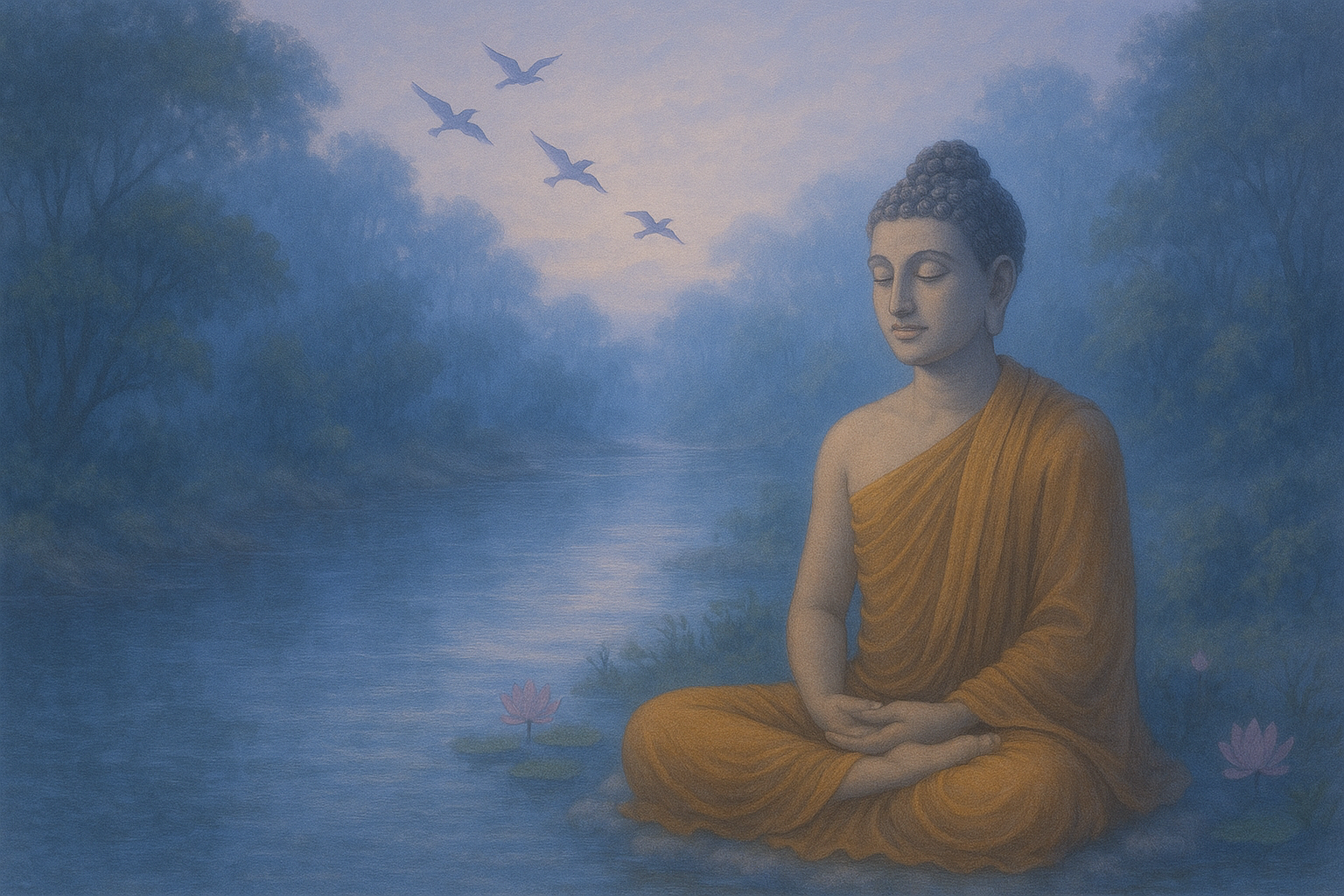
There was once a prince who had everything the world could offer—luxury, beauty, youth, and power. Yet, beneath the silken robes and palace gardens, something stirred in him—a quiet question, a restlessness not even pleasure could soothe. One morning, while the city still slept, Siddhartha left behind everything familiar. He left not in sorrow, but in wonder. He left not to escape life, but to find it.
This journey was not toward something new, but toward something eternal that lives quietly within each of us.
He wandered forests and sat with sages. He fasted, he listened, he watched. But truth did not reveal itself through extremes. Only when he turned inward—beneath the canopy of a bodhi tree, alone with the night and the breath—did the world fall away. And there, not in effort but in surrender, not in conquest but in stillness, he awoke. The morning star rose—and with it, so did the light within.
What did he see in that silence? He saw that everything arises and passes. That nothing can be held, yet nothing need be feared. That peace is not found in perfecting the world, but in embracing it as it is. That love—boundless, formless love—is our truest nature when the fog of self has lifted.
And so began not a religion, but a path. A way of being. A return to simplicity. A return to presence.
“Peace comes from within,” the Buddha said. “Do not seek it without.”
The path he shared was not paved with commandments, but with invitations. To breathe. To listen. To be awake in a world that so often dreams. He did not ask us to follow him. He asked us to follow our own knowing, to sit beneath our own tree and wait for our own dawn.
In every step he took, the Buddha showed us that enlightenment is not somewhere we arrive—it is how we walk. It is how we touch the earth with bare feet and open eyes. It is how we meet each moment—not with control, but with compassion.
To walk this path is not to renounce the world, but to rediscover it. To see in the smallest gesture the entire cosmos reflected. To drink from the cup of life without thirst or clinging. “When you realize how perfect everything is,” he said, “you will tilt your head back and laugh at the sky.”
Freedom, for the Buddha, was never a future reward. It was the falling away of what we no longer need: the noise in the mind, the grasping of the heart, the illusions of fear. Like clouds drifting from the face of the moon, the path clears by itself when we stop chasing it.
He invited us to become intimate with the breath, that soft rhythm of being we so often forget. To sit not to escape, but to arrive. To notice the breeze on the skin, the rising of emotion, the miracle of thought. Not to judge, but to watch. Not to hold, but to let pass. In this attention, the world becomes luminous again.
“Be where you are,” the Buddha whispered through silence. “Otherwise, you will miss your life.”
What makes his teaching so liberating is that it offers no gatekeeper. There are no conditions to meet, no worthiness to prove. The lotus does not wait for perfection to bloom—it rises even from the mud. Likewise, the path opens wherever we are: in grief or joy, in stillness or chaos, in the sacred or the mundane. In peeling an orange. In holding a loved one. In walking under rain.
To awaken is not to become someone new. It is to remember who we are when nothing is missing.
We live in a world that constantly tells us we are not enough, that happiness lies one achievement, one possession, one transformation away. But the Buddha’s gaze pierced through this illusion. “You yourself, as much as anybody in the entire universe, deserve your love and affection,” he said.
Self-love, for him, was not indulgence but truth. We are already the sky—vast and clear. The storms come and go, but the sky remains untouched. The more we recognize this spaciousness within, the less we are thrown by life’s shifting winds.
And so the Buddha smiled often—not because life was without difficulty, but because he had learned not to resist it. His was a joy deeper than pleasure, a serenity deeper than stillness. Not because he escaped suffering, but because he saw through it.
“Let go of what has passed. Let go of what may come. Let go of what is happening now,” he taught. “Don’t try to figure anything out. Don’t try to make anything happen. Relax, right now, and rest.”
These are not instructions—they are an invitation to come home. To the body. To the moment. To the mystery that breathes us.
The way to enlightenment is not up a ladder, but down into the heart. It is not about effort but about surrender. Not about escape but about arrival.
The Buddha’s path is, at its essence, the art of being fully alive. Of walking gently. Of loving freely. Of letting go. And in this simplicity, the profound is revealed.
There are no rules here, only reminders: that this moment is enough, that this breath is sacred, that this life, with all its mess and magic, is your path. The one you’ve been looking for.
So let your life become the practice. Let silence become your teacher. Let love become your path. Enlightenment is not somewhere else. It is not someone else’s story. It is yours.
It is here.
Now.
In you.
And when you realize it, truly realize it, perhaps you too will smile like the Buddha, quietly, gently, with the peace of one who has finally remembered the way home.
****
~Siddhartha Gautama, known as the Buddha, was born around the 6th century BCE in Lumbini, in present-day Nepal. Born into a royal family, he renounced worldly life in search of deeper meaning and liberation from suffering. After years of spiritual seeking, he attained enlightenment under the Bodhi tree in Bodh Gaya, India. From that moment, he became “the Awakened One” — the Buddha — and spent the rest of his life teaching a path of inner peace, mindfulness, and compassion. His teachings gave rise to Buddhism and continue to inspire millions on the journey toward awakening and inner freedom.
Excellence Reporter 2025





 Excellence Reporter
Thank you, Nicolae. Â It occurs to me that Buddhism, which is a formal religion with approx. 324 million adherents — about 4.1% of the global population — has a certain level of commonality with GoldenRuleism. GoldenRuleism is not a formal religion, per se, of course. Â However, it’s elegantly simple “Two Principal Principles” could be the foundation for one; akin to the fact that the Golden Rule is foundational to all the world’s major religions. “Do for all others, both directly and indirectly, what you would want done for you. Â Don’t do to any others, either directly or indirectly, what you wouldn’t want done to you.” The line you wrote appeals to me: Â “And so began not a religion, but a path. A way of being. Â A way of simplicity. Â A return to presence.” I have hope that the approx. 5 billion people of various faiths and spiritual beliefs will come together around the common bond represented by the overarching ethic of GoldenRuleism. Sadly, “religious differences” have, over the centuries, fomented a rather continuing onslaught of conflict and violence and the immense suffering and death to “Mankind” which results. If only the various “folks of faith” had chosen to always come together around the rule they all hold in common, the Golden Rule — which I deem to be “Humanity’s Number One Rule.” That hasn’t happened, but now the world can come together in the evolutionary version of the original Golden Rule. Anyone anywhere, even if they’re not folks of faith, can embrace and live by the common bond of GoldenRuleism — which clearly does not permit such conflict, violence, suffering, and death to take place among truly civilized societies. In order for people to “see” the value of the overarching ethic of GoldenRuleism, we’ll have to “A.S.K.” (Ask — Seek — Knock) them to see it. As Marilyn Turkovich wrote in her personal endorsement of the GoldenRuleism booklet: Â “It is time. Â We can’t afford to wait.” Our GoldenRuleism Team appreciates the deep depth of your thinking and journalism. Â Ideally, you’re a GoldenRuleism Ambassador who helps us “spread the word of GoldenRuleism” worldwide. Â We believe that virtually everyone everywhere will benefit by having “The Good of GoldenRuleism” in their lives. Craig P.S. Â I sent the GR A logo at the very bottom below. Â The info. about GoldenRuleism Ambassadors is on the Team’s website under the heading Ambassadors.
LikeLike
Thank you Craig!
LikeLike
You’re welcome, Nicolae — thank you!
LikeLike