
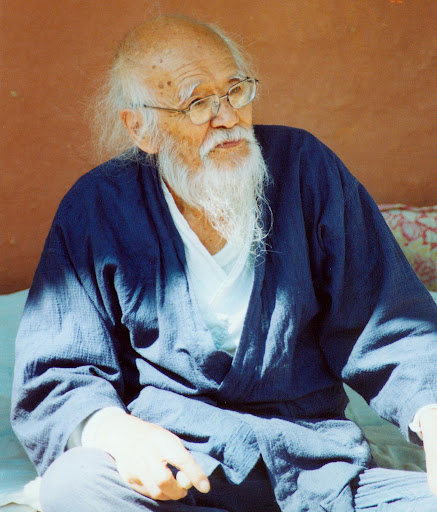
In a world obsessed with growth, speed, and control, Masanobu Fukuoka offered something radically different: stillness, simplicity, and surrender.
A farmer, scientist, and philosopher, Fukuoka spent much of his life challenging the assumptions of modern agriculture—and modern life. His approach, called natural farming or the “do-nothing method,” wasn’t about laziness. It was a profound return to nature’s intelligence, a way of being that sought harmony rather than dominance.
“The ultimate goal of farming is not the growing of crops, but the cultivation and perfection of human beings.”
This was the heart of Fukuoka’s philosophy. Farming, to him, was never just about food. It was a mirror for how we live. In abandoning unnecessary effort in the field, he found a blueprint for how we might live more gently in the world—by letting go.
Letting Nature Lead
Fukuoka began as a trained microbiologist, working in plant pathology. But in his 20s, he experienced a deep existential crisis that led him to abandon his career and return to the countryside. What followed was decades of experimentation—and quiet rebellion.
Modern farming relied on plowing, chemicals, and relentless human intervention. But Fukuoka asked: what if nature already knows what to do? What if, instead of bending the land to our will, we cooperated with it?
So he stopped tilling. He stopped using fertilizers, pesticides, and machinery. He planted seeds with minimal disturbance, often coating them in clay and scattering them by hand. He let weeds grow and used them as mulch. He allowed rice to grow in unplowed fields, alongside clover and other natural cover crops. And it worked.
He produced abundant harvests year after year, all while restoring soil health and biodiversity. And he did it by observing, trusting, and intervening only when truly necessary.
“Nature is complete and self-sufficient. Human knowledge, when separated from nature, is incomplete and can lead to destruction.”
A Philosophy of Non-Intervention
Fukuoka’s method was not about doing nothing in the literal sense. It was about doing only what is needed. He stripped away layers of intervention until only the essential remained. His work was as much spiritual practice as farming.
This philosophy extended to life itself. Fukuoka believed that so many of our problems—pollution, stress, disease—stem from doing too much, from interfering with natural rhythms, from trying to solve problems we created through the very act of overthinking.
“The more people do, the more society loses the ability to function. Eventually, all that’s left is the barren land, both literally and spiritually.”
It’s a hard truth: we complicate life in our attempts to control it. We micromanage nature, relationships, careers, even our own minds. But what would happen if we stopped pushing so hard?
Fukuoka’s answer was not passive retreat, but conscious alignment. He lived a life of purpose and intention—rooted in observation, humility, and service to the land.
Nature as Teacher
To Fukuoka, nature was not a resource. It was a teacher.
He believed that real understanding comes not through analysis but through direct experience—through watching a seed sprout, listening to the wind move through the rice, seeing the same mountain change through the seasons. He urged people to stop reading about nature and start living with it.
“I do not particularly like the word ‘work.’ Human beings are the only animals who have to work, and I think this is the most ridiculous thing in the world. Other animals make their livings by living, but people work like crazy, thinking that they have to.”
This isn’t a call to laziness. It’s a call to reconsider what meaningful work really is. When we align with natural cycles, when we grow food with care, when we take only what we need, when we slow down—we rediscover a kind of joy and clarity that industrial life erases.
Nature does not hurry, and yet everything gets done.
The Inner Landscape
Fukuoka’s writings in The One-Straw Revolution and The Natural Way of Farming are more than manuals. They are meditations. He often wrote about the inseparability of inner and outer landscapes. Heal the soil, and you heal the soul. Restore balance in the field, and you begin to restore balance in yourself.
He saw ego as the root of many problems. The ego that says I know better than the forest. I know better than the river. I can fix this. But Fukuoka’s life was one long unlearning of that arrogance.
“The foolishness of human beings is the belief that they can improve upon nature.”
When we humble ourselves, when we admit we don’t know, when we observe instead of react—then we begin to really see. Not just the world outside, but the world within.
Lessons for a Fractured World
In the age of climate crisis, mass extinction, and mental exhaustion, Fukuoka’s insights feel more urgent than ever.
His method won’t work in every field or every context, but his philosophy transcends geography. It invites us to question our assumptions. To slow down. To let go of unnecessary striving. To rebuild our connection with the earth, and with ourselves.
Fukuoka never wanted to create a movement or an ideology. He simply wanted people to return to the essence of life. And for him, that meant living close to nature—with humility, with awareness, and with trust.
“If we throw mother nature out the window, she comes back in the door with a pitchfork.”
The earth is not ours to fix. It is ours to care for. And often, the most powerful thing we can do is to stop interfering—and start listening.
Conclusion: The Quiet Revolution
Masanobu Fukuoka didn’t lead protests. He didn’t build empires. He sowed seeds—quietly, persistently, with reverence.
His was a revolution of stillness. A protest of presence. He taught that true change doesn’t always come from effort, but from alignment. From stepping aside and allowing life to unfold, as it always has.
In the end, his greatest teaching wasn’t how to grow food, but how to live:
“The ultimate goal is not to live in nature, but to become nature.”
And in doing so, perhaps we find a better way—not just to survive, but to belong.
***
~Masanobu Fukuoka (1913–2008) was a Japanese farmer, philosopher, and author best known for pioneering the concept of natural farming—a method that works with, rather than against, nature. Originally trained as a microbiologist, Fukuoka rejected industrial agriculture and modern science’s attempts to dominate the natural world. Through decades of observation and practice, he developed a “do-nothing” farming method that requires no tilling, no chemical fertilizers, no pesticides, and minimal human intervention.
Fukuoka’s groundbreaking book, The One-Straw Revolution, has become a foundational text in sustainable agriculture and ecological living. His philosophy goes beyond farming—it is a call to live simply, humbly, and in deep relationship with the Earth.
©Excellence Reporter 2025
Share this:

Categories: Awakening, Health & Wellness, Life, Nature, Sustainability, Wisdom of Life




 Excellence Reporter
Wonderful article, which we plan to share on our site as a Positive News in June. May we use the image? Thanks for publishing this story! Manuela https://gentleartofblessing.org/positive-news/
“Each of us is intended to be a blessing to all the earth: the animal world, the vegetable world, the mineral world, the human world.” Joel S. Goldsmith “La personne la plus importante est toujours celle qui est à l’instant en face de moi”. Maître Eckhar https://www.babelio.com/auteur/Maitre-Eckhart/28353t https://www.babelio.com/auteur/Maitre-Eckhart/28353
https://www.facebook.com/ppradervand/
https://gentleartofblessing.org/
http://pierrepradervand.com/
https://www.facebook.com/groups/316404038484282/
https://www.facebook.com/groups/711463475570039
LikeLiked by 1 person
Yes Manuela, no problem. Thank you!
LikeLike