
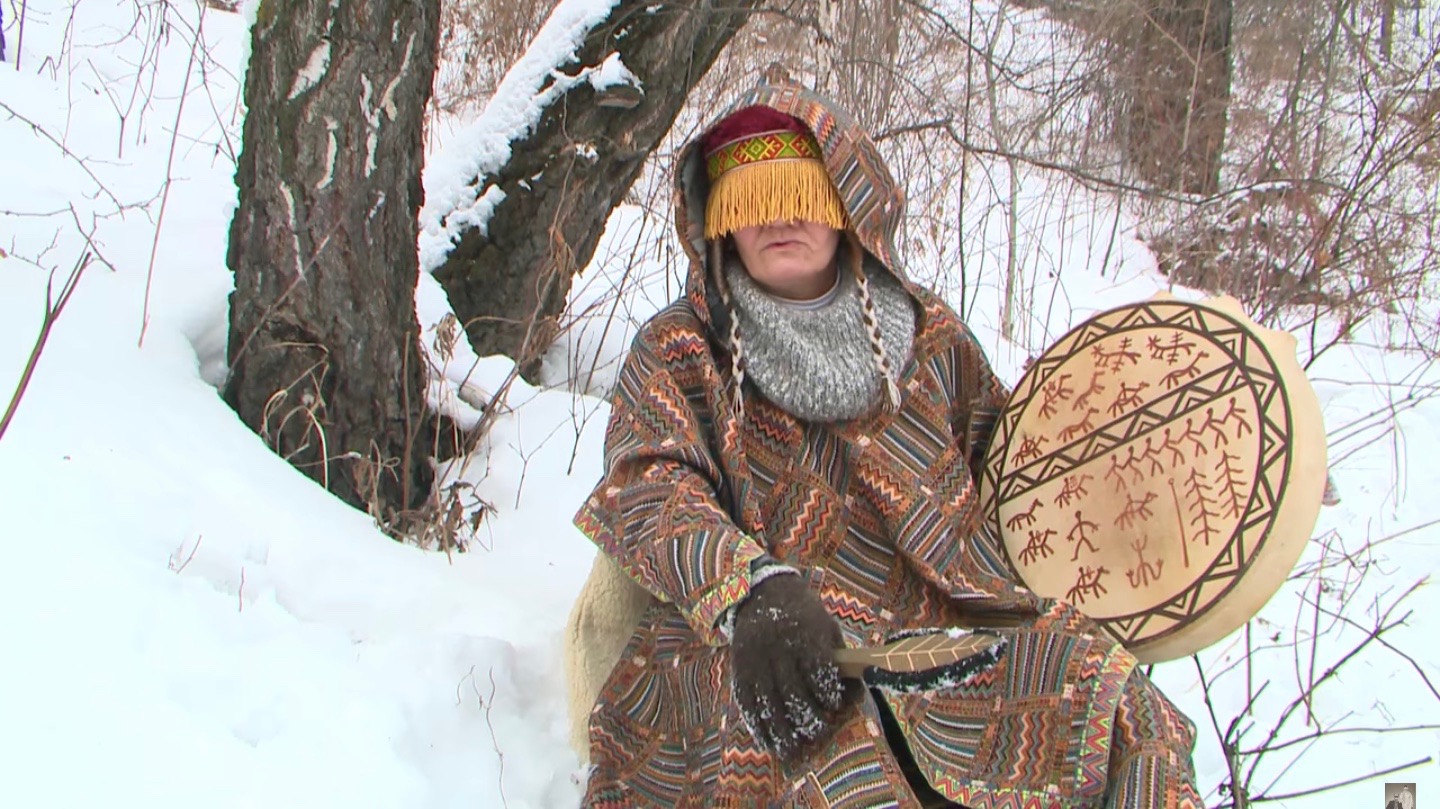
Alya, a Siberian shaman who wished to remain anonymous, shares her insights in this interview. The conversation was filmed by the TV channel Russia-Culture in collaboration with Ethno Taiga and has been translated into English by ©Excellence Reporter.
Q: There are shamans in Siberia, but who are they? Most people probably don’t know much about them. What do they represent?
Alya: Yes, unfortunately, most people have no real understanding of what a shaman is, who they are, what they do, and why they do it. Many have preconceived notions, and as a general rule, people fear what they do not understand. Shamans are often feared, sometimes even vilified. People spread all kinds of rumors. In reality, it is much easier to dismiss or distort something than to truly accept and understand it. Of course, not everything a shaman does is immediately comprehensible. That’s why I want to provide some clarity.
A shaman is someone who perceives the subtle realms—the unseen worlds. These realms are inhabited by spirits, and most shamans can see and communicate with them. In the spirit world, everything is known; there is no falsehood or deception. When a shaman enters this realm, they can receive answers to any question.
For example, if someone comes to a shaman seeking healing, the shaman may not initially know what to do, especially if they have never encountered such a case before. Through rituals—both traditional and personal—they enter the spirit world and ask for guidance. The answers come directly from the spirits, allowing the shaman to assist in the healing process. This is the sacred aspect of shamanism. A shaman who cannot heal is not truly a shaman. After all, what is the point of disturbing the spirit world if there is no purpose in doing so?
A true shaman channels the power of the spirits correctly. Some shamans are even connected to the gods. Those who truly embody this power do not need to heal themselves, as the energy constantly flows through them, keeping them balanced and harmonious. A real shaman is fearless—unafraid of death, unafraid of anything. If you fear something, there is something you cannot do. A shaman’s purpose is to help those who do not understand, who do not know, who do not have the ability to help themselves.
Q: Is someone born a shaman? Were you born into a shamanic family? Was there a sign that you would become a shaman?
Alya: When I was five years old, my great-grandmother passed something on to me—she laid her hand on me, so to speak. It took many years before I truly understood what it meant. But I will say this: being a shaman is a duty, a responsibility. It is not easy. When you begin to help others, you stop living for yourself. You serve others. It is a kind of self-sacrifice.
And at some point, you almost die. Because… there is this feeling of home, of a homeland—you know? A place you never want to leave, where you always want to return. There is something magnetic about it, something special. I don’t know… It’s as if a part of you belongs there. And when you return, you feel whole again. No matter how empty you arrive, being home allows you to recover quickly, to regain strength.
No artificial tools are needed for rituals. You simply go into nature, lie down on the earth, look at the sky, the clouds, wash with clean water, and breathe fresh air. You light a small fire. And you feel the blessing of it. The power of the fire—how gentle and noble it is. It is miraculous. Whatever you ask for, nature responds. But, of course, one must learn to feel this connection. It does not happen immediately.
Q: Alya, did you have a teacher? Did your grandmother guide you?
Alya: I had two master-teachers. One of them guided me, and I learned from them, though mostly in theory. But I believe that before you take an instrument into your hands, you must understand what it is that you are holding. There must be a sense of responsibility. It’s not just about wanting something and rushing ahead blindly. No. Fortunately, my parents instilled this sense in me. It’s like holding a knife—you must know how to use it.
Beyond living for yourself, you begin to live for others as well. This is not easy. And not doing it is not an option, because you have been given this gift. You have a calling, and you must make something of it.
Q: As a child, did you ever imagine becoming a shaman? Didn’t you have a profession? Where did your life change?
Alya: I bake bread and build stoves for a living. After school, I studied construction engineering. I love creating beautiful masterpieces, because when people see them, they are filled with joy. And I know they will look at them every day, so they must be beautiful. Perhaps, on some level, I intuitively understand that I love bringing joy to others. Why? Because I feel despair when I cannot help someone, when they do not know how to find joy themselves.
Life without joy is meaningless. One must be able to experience joy. For me, I once felt overwhelming joy when I lit a fire. I was filled with it, and from that joy, I even shed tears. That is happiness. What is happiness? It is feeling yourself as part of something vast and great. To become one with it. Happiness is merging with that greatness.
Q: Alya, have you ever had to die on this path?
Alya: I have died four times. I know what death is. The last time, I could completely control the experience. I died, and I immediately came back.
Remember, every death is a rebirth. What they say in church is true—death does not exist. When you leave one state, you are born into another.
Q: What is the most difficult thing for a shaman?
Alya: The worst thing is not doing what you are capable of. It’s like a doctor walking past a patient in need of help. That is the most terrible thing. It is shameful. It is disgraceful. It is unforgivable.
Q: Who comes to you for help?
Alya: Mostly people who have been frightened by doctors. But overall, people do not come often. Local people, in particular, rarely come, because they know how to help each other. Healing is passed down through generations. It is something natural. In every family, at least one person knows how to heal. That is normal. They do not need me for that.
Q: You mentioned animal totems. What is a totem?
Alya: A totem is the spirit of an animal. For example, today I threw a piece of meat to call the totems. We are in the forest—this is their domain, their element. We are in their territory, and we must show respect.
I have a few totems. One is the white owl; another is the marten. They come to you, and you simply know—they are yours. The most powerful totem for any shaman is the bear. Those with the bear totem protect others. They are strong and powerful.
Q: Alya, where does music come from?
Alya: When you are alone, surrounded by vastness, fresh air, stillness, and nature, you merge with it all. And suddenly, you stop feeling the ground beneath you—you feel as if you are flying. This feeling of flight frees the soul. The soul opens, and it begins to sing. It happens on its own.
The most amazing thing is that when someone else hears these songs, they remember them. But I, no matter how much I sing, never remember them myself. The songs come from somewhere deep inside, like waves rising, filling you with images and meaning—even if the language is unfamiliar, you understand. That is a real song—one that comes from the soul. Not something composed for money, but something true.
Q: Alya, do you have anything to be grateful for in your life?
Alya: I am grateful for my parents, for my father and mother. I am grateful for the moment when I became aware of this great world—the spiritual world. I am thankful to the guardians of that world who help us exist here, who allow us to draw from their power, to live, and to grow into better versions of ourselves.
Copyright © 2018 Excellence Reporter





 Excellence Reporter
A timely discussion to find. Your story and wisdom has been enlightening for my soul
LikeLike
Words of Wisdom that I will Carry along in my heart.
LikeLike
Reblogged this on owlmirror and commented:
This one rings true…..
thanks to all involved
LikeLike
thank you for your service to people and nature…praying to be the spirit I was meant to be..please pray for me
LikeLike
Very interesting interview. Thank you for translating it. I hope my travels take me to Siberia one day.
LikeLike