
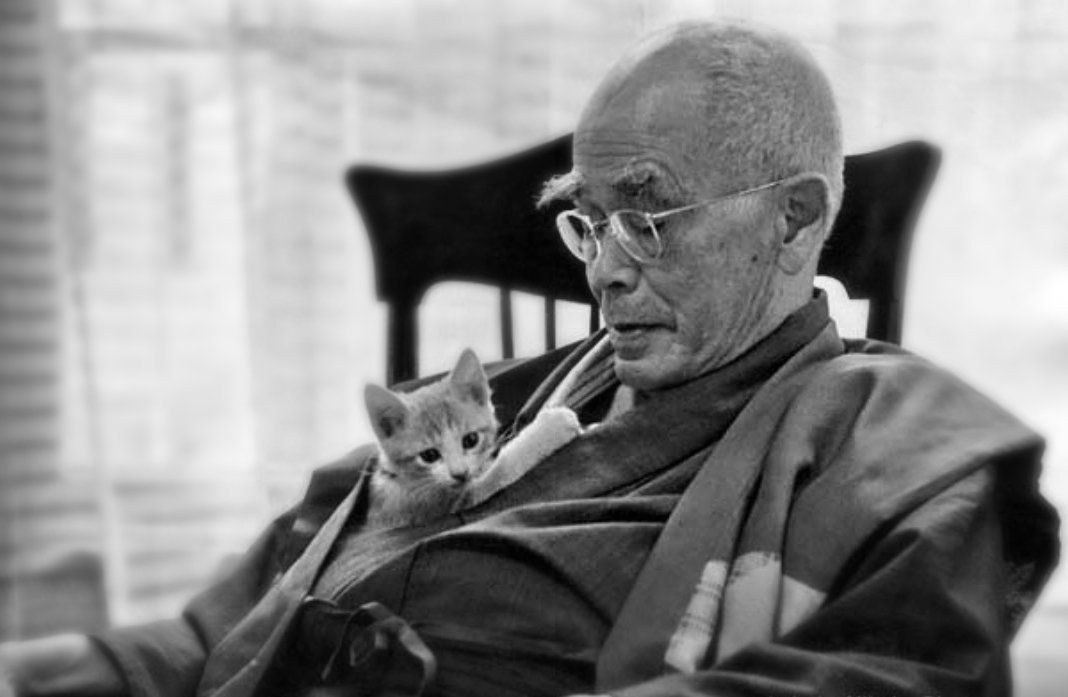
In the great transmission of Zen from East to West, few voices have resonated as clearly, as gracefully, and as profoundly as that of Daisetz Teitaro Suzuki. A philosopher, translator, and spiritual ambassador, Suzuki dedicated his long life to revealing the heart of Zen—not merely as an intellectual tradition, but as a living experience, an open doorway into the mystery of existence. Through his writings, lectures, and translations, he offered a way of seeing life that is at once deeply simple and infinitely rich—a way rooted in presence, in awareness, in a direct and unmediated encounter with the flow of being.
At the core of Suzuki’s message lies a gentle but radical invitation: to let go of the compulsion to grasp life with the analytical mind, and instead to experience it with the whole of one’s being. “Zen,” he wrote, “is not a system of philosophy, nor a religion, nor a psychology. It is a state of consciousness, or rather a state of being.” In these few words, Suzuki points us to the essence of Zen and of life itself—not as something to be explained or believed, but as something to be lived with immediacy, with openness, and with a deep attunement to the present moment.
Suzuki invites us to consider that our ordinary, dualistic mind—the mind that divides reality into subject and object, self and other—is the very source of human suffering and confusion. True freedom, he taught, comes when we transcend this dualism and awaken to life as it is, in its original, undivided wholeness. “To understand Zen,” he said, “is to understand what life is, and not merely the meaning of life.”
This is a subtle but crucial distinction. The search for the meaning of life is a product of the analytical mind, forever reaching outside of the present moment. In contrast, Zen—and Suzuki’s philosophy—points us toward the suchness of life: the direct, unmediated experience of existence here and now. “Zen is the art of seeing into the nature of one’s own being,” Suzuki wrote, “and it points the way from bondage to freedom.”
To see into our own nature is to awaken to the truth that the world and the self are not separate. The waves are not apart from the ocean; they are the ocean in motion. In the same way, the individual self is not apart from life itself. It is life, expressing itself moment by moment. Suzuki captured this beautifully: “When I look carefully, I see the nazuna blooming by the hedge.” In this simple observation—drawn from a Zen poem—Suzuki reveals the profound truth that life’s essence is found in the ordinary, the immediate, the here and now.
Yet, how difficult it is for the modern mind to dwell in such simplicity! Conditioned by striving and ambition, we tend to seek fulfillment in distant goals, future achievements, or abstract concepts. Suzuki warned against this tendency: “We must learn to let things take their natural course and to refrain from interfering with the great scheme of things.” Life unfolds naturally, he taught, and our task is not to control it, but to participate in it fully, with openness and humility.
Central to this participation is the practice of no-mind (mushin), a state in which thoughts, concepts, and judgments no longer obstruct our direct experience of reality. “No-mind is the natural condition of all things,” Suzuki explained. “It is only when we become conscious of ourselves and of our surroundings that we are liable to be confused.” In no-mind, the self becomes transparent; life flows through us unimpeded.
This state is not something to be forced or manufactured. It arises naturally when we let go of attachment to ego and ideas. “Zen,” Suzuki reminded us, “is not attained by thinking, for thinking is an obstruction to Zen. It is not attained by doing, for doing is also an obstruction. Zen is attained by a flash of intuition, which brings us to a new perspective.” This flash of insight—known as satori—is not an intellectual understanding, but a direct experience of unity with life itself.
Such awakening transforms not only the way we see the world, but also the way we act within it. For Suzuki, Zen was not an escape from life, but an immersion in its heart. “Zen is not a retreat from the world, but an encounter with the world as it is,” he wrote. In this spirit, he urged us to live with compassion, mindfulness, and an appreciation for the sacredness of everyday existence.
Indeed, Suzuki’s writings repeatedly return to the beauty of the ordinary: the sound of rain on leaves, the play of sunlight on water, the laughter of a child. In these simple moments, we touch the timeless truth of life. “Each particular object is the whole of Reality,” Suzuki wrote. “When you see a flower, you see the entire universe in that flower.”
This vision leads us to a profound sense of harmony with all things. No longer caught in the illusion of separation, we experience life as a great, interconnected whole. Suzuki wrote: “When the mind is free, the whole world surrenders. When the mind is free, life reveals itself in its endless creativity.” In this state of inner freedom, we cease resisting the flow of life and begin to dance with it.
To live in this way is to embody the spirit of Zen. It is to meet each moment with openness, to embrace impermanence, and to find joy in the simple act of being alive. As Suzuki put it: “The meaning of life is to live.” Not to seek, not to analyze, but simply to live—with awareness, gratitude, and compassion.
In the end, Suzuki’s philosophy invites us home to ourselves. It calls us to relinquish the endless striving of the conceptual mind and to rest in the natural, effortless flow of life. In doing so, we awaken to a deeper dimension of being—one in which every breath, every step, every gesture becomes an expression of the great mystery that animates all things.
For those seeking a life of authenticity and depth, Suzuki’s words remain as vital today as when he first penned them: “Zen in its essence is the art of seeing into the nature of one’s own being, and it points the way from bondage to freedom.” In this freedom, we rediscover the true gift of life: the simple, radiant joy of presence.
****
~Daisetz Teitaro Suzuki (1870–1966) was a renowned Japanese scholar, Zen Buddhist philosopher, and author who played a pivotal role in bringing Zen Buddhism and Eastern philosophy to the West. Through his many books, essays, and translations, Suzuki introduced Western audiences to the core principles of Zen, emphasizing direct experience, mindfulness, and the unity of life. His clear, insightful writings continue to inspire
Excellence Reporter 2025
Share this:

Categories: Wisdom of Life, Zen





 Excellence Reporter