
“Life and death are of supreme importance. Time swiftly passes by and opportunity is lost. Each of us should strive to awaken. Awaken! Take heed, do not squander your life.”
“When you walk, just walk. When you sit, just sit. But above all, don’t wobble.”
“Enlightenment is intimacy with all things.”
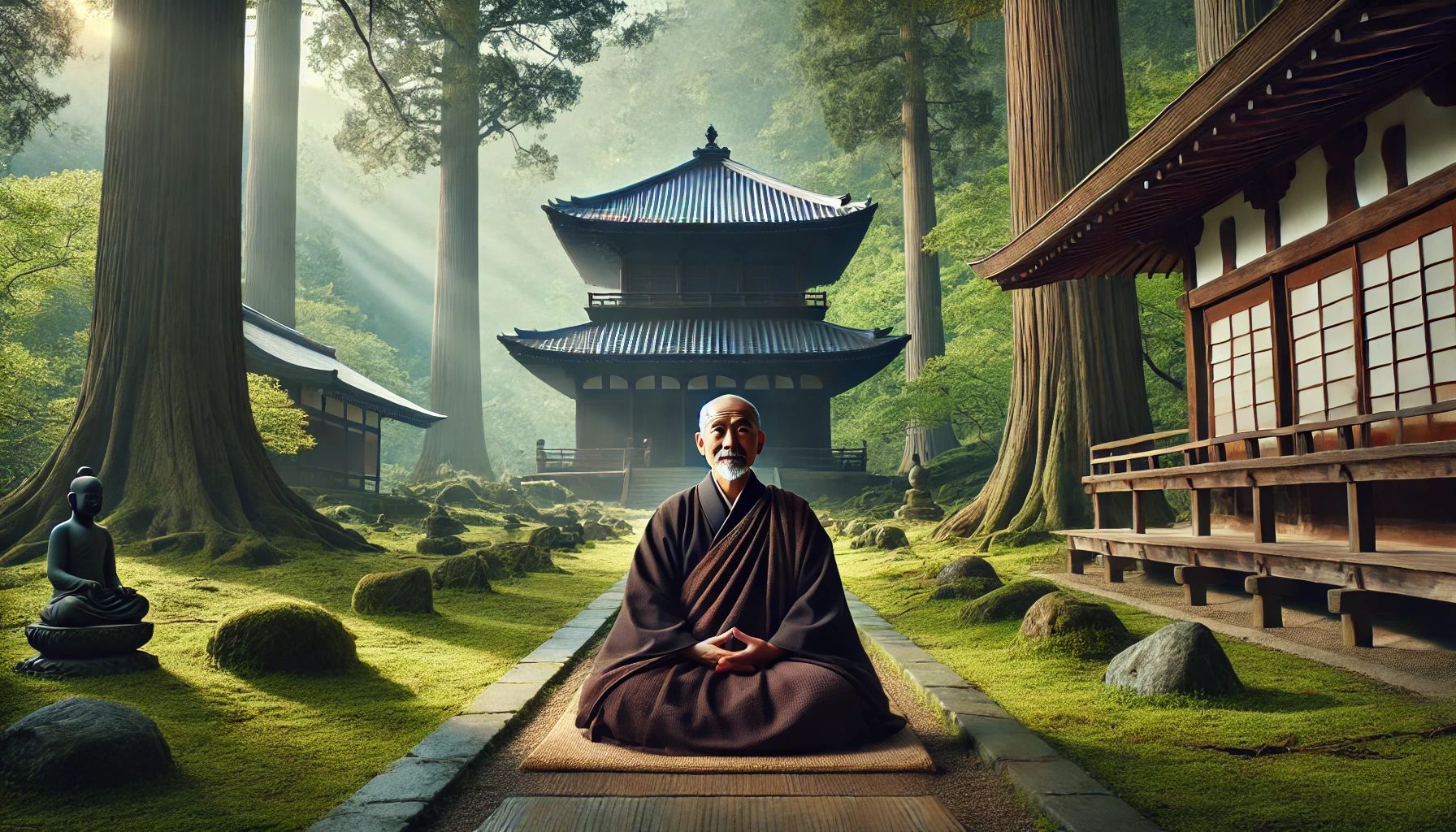
In the 13th century, a Japanese monk named Dōgen Zenji crossed turbulent seas to China in search of truth. What he brought back was not a new religion or a revised scripture, but a clear, radical vision of life: that enlightenment is not a distant goal but the living breath of this moment. Dōgen’s philosophy challenges every assumption we make about success, time, self, and meaning. His voice rings through centuries, calling us not to change life, but to see it—really see it—for what it already is.
“If you cannot find the truth right where you are, where else do you expect to find it?”
Practice Is Enlightenment
At the core of Dōgen’s view of life is shikantaza—“just sitting.” Not sitting to achieve something, but sitting with complete presence. This is the cornerstone of zazen, Zen meditation. But Dōgen was never just talking about sitting on a cushion. He meant life itself should be lived in this way: nothing added, nothing taken away.
“To study the Buddha Way is to study the self. To study the self is to forget the self. To forget the self is to be actualized by myriad things.”
This statement isn’t mystical wordplay. It’s a dismantling of the ego. For Dōgen, life isn’t about reinforcing a personal narrative. It’s about letting go of that narrative so reality can reveal itself. When we forget the self, we stop measuring, comparing, and trying to control. We start responding directly to what is—raw, unscripted, alive.
Time Is Not What You Think
One of Dōgen’s most provocative teachings is his essay Uji (“Being-Time”), where he flips our idea of time on its head. We think time passes. Dōgen says: you are time. Every moment is a complete expression of your being. There is no abstract “past” or “future” apart from now.
“Time itself is being, and all being is time. In each moment, time is all being, and each being is all time.”
This isn’t philosophical decoration. It’s a wake-up call. We spend so much life waiting—waiting for the weekend, the promotion, the perfect partner. Dōgen’s teaching strikes through that: this moment is not a stepping stone—it’s the whole path.
So if you’re washing dishes, wash dishes with your whole body-mind. If you’re driving, drive like it matters. Not for a result. Not as a placeholder. But because this moment is reality itself, and it will never come again.
Enlightenment Is Not Elsewhere
Many spiritual paths speak of enlightenment as a kind of escape—a transcendence from pain, desire, and limitation. Dōgen rips down that divide.
“Those who seek the truth by means of intellect and learning only get further and further away from it.”
To Dōgen, enlightenment is not a higher realm. It’s baked into every detail of daily life. Enlightenment is your breath fogging up the mirror. It’s the sound of your neighbor’s door closing. It’s your heartbeat while you read this sentence.
But here’s the twist: you won’t find it if you’re looking for it. Dōgen insists that seeking separates us from what already is. Practice isn’t about gaining. It’s about full participation.
“Do not follow the ideas of others, but learn to listen to the voice within yourself. Your body and mind will become clear, and you will realize the unity of all things.”
This is a hard teaching. We want answers, signposts, guidance. Dōgen gives us a broom and says: sweep the floor like the universe depends on it. Because it does.
The Sacred Is Ordinary
Dōgen’s genius lies in collapsing the distance between sacred and mundane. For him, the kitchen is no less holy than the temple. He famously wrote a treatise for monks on how to cook—Tenzo Kyōkun—not just to guide meals, but to show that how we chop vegetables reveals our state of mind.
“The way you serve food is the way you serve the Buddha.”
In modern life, we look for transcendence in retreats, apps, or exotic rituals. Dōgen says: it’s in the way you tie your shoes. It’s how you speak to your child. It’s how you show up when no one is watching.
His message is not glamorous. It’s relentless. But it’s liberating. There’s nowhere to get to. No perfect version of yourself to become. There’s only this—the immediate, undivided now.
No Separation
One of Dōgen’s most profound contributions is his view of non-duality—not just as a concept, but as lived truth. In his essay Genjōkōan, he writes:
“When one side is illuminated, the other side is dark.”
This isn’t about moral dualism. It’s about how reality always contains its opposite. Joy arises with sorrow. Gain rides with loss. Trying to separate or fix one side is futile. Wisdom is in embracing both.
Dōgen’s life wasn’t easy. He lost his parents young. He walked thousands of miles seeking a teacher. He faced opposition in his homeland. But none of this broke him. It sharpened his insight: life is not what happens to us, but how completely we engage with it.
“In a mind clear as still water, even the waves, breaking, are reflecting its light.”
What Dōgen Means for Us Now
Dōgen lived in a monastery. We live in traffic jams, inboxes, crowded rooms. But the gap isn’t as wide as it looks. His teachings are perfectly suited for this moment in history—when we’re drowning in distraction and craving meaning.
He doesn’t offer comfort. He offers clarity. He’s not asking you to change your life. He’s asking you to live it without filters.
To follow Dōgen is to practice with no promise of reward. To act with integrity when no one notices. To see your next breath as sacred.
It means sitting in silence not to escape noise, but to hear what the noise is saying.
It means accepting uncertainty not as a problem, but as the ground of being.
And it means realizing that the self you’re trying to improve has never been separate from the universe in the first place.
“Mountains walk, and so do I. The blue mountains are constantly walking.”
In Dōgen’s world, even the mountains move, even the rocks are alive, even this ordinary moment is a miracle.
So what is life, according to Dōgen?
It’s not a riddle to solve. It’s a fire to sit beside. It’s a gate you enter by being exactly where you are.
And once you see that, nothing is ever ordinary again.
****
~Eihei Dōgen (1200–1253) was a Japanese Zen master, poet, and philosopher who founded the Sōtō school of Zen in Japan. At the age of 24, disillusioned with conventional Buddhism, he traveled to China in search of authentic practice. There, he experienced a profound awakening and brought back the essence of zazen—“just sitting”—as the heart of the Way.
Dōgen’s writings, especially his masterwork Shōbōgenzō (“Treasury of the True Dharma Eye”), are not abstract theories but fierce invitations to live fully, here and now. He taught that enlightenment is not something to attain, but something to express in every act—cooking, walking, breathing.
To Dōgen, time is being. Practice is realization. And the sacred is never separate from the ordinary.
Excellence Reporter 2025
Share this:

Categories: Zen






 Excellence Reporter