
What is life?
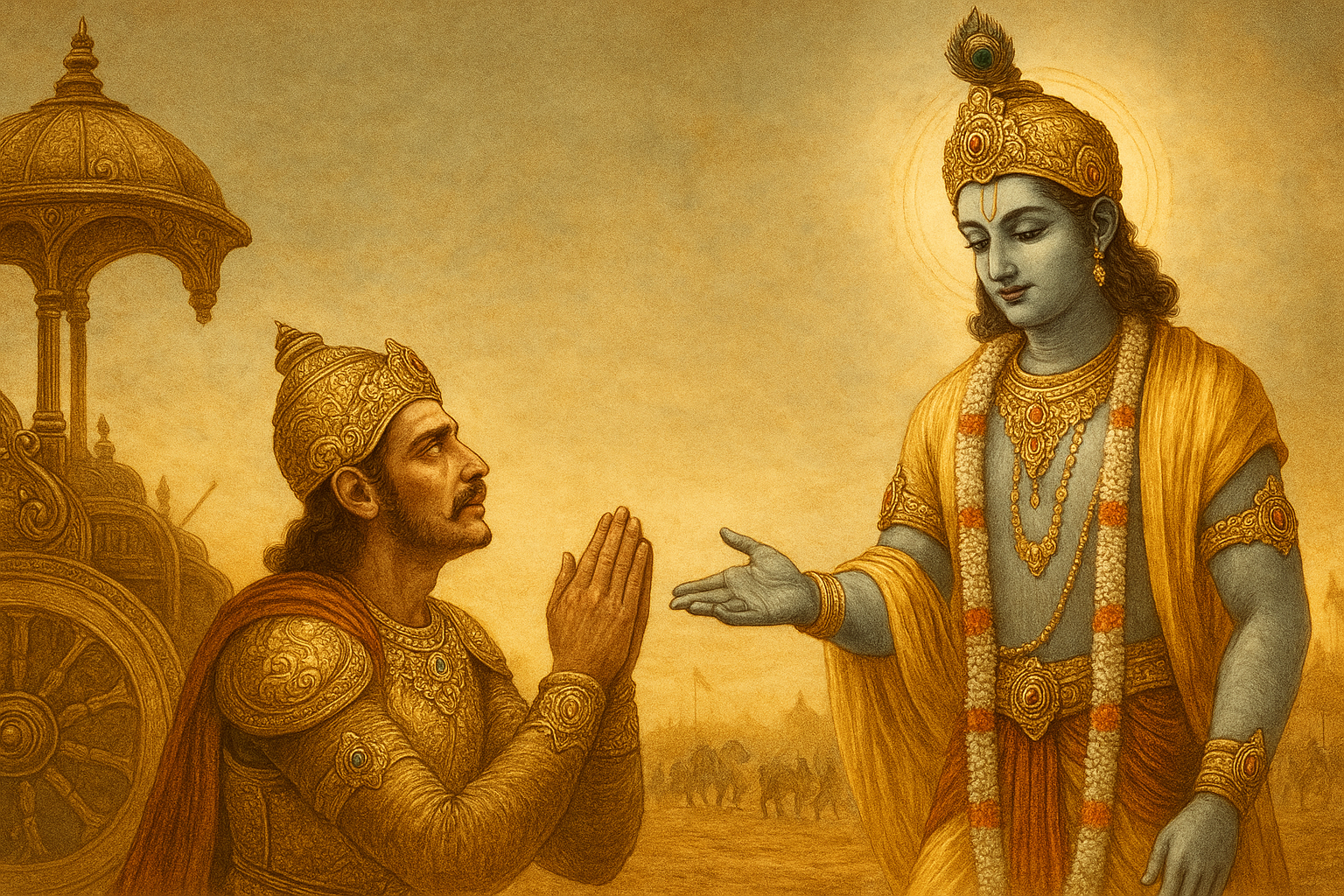
The Bhagavad Gita doesn’t answer with philosophy alone—it answers with fire. Spoken in the heart of a battlefield, between a warrior prince on the edge of collapse and a divine guide revealing the nature of reality, the Gita doesn’t shy away from the hardest truths: that life is full of conflict, that duty is rarely easy, and that clarity must be forged in the heat of struggle.
But it also delivers a radical kind of hope—one grounded not in comfort, but in consciousness. The Gita strips life down to its essence: You are not your fear. You are not your failure. You are not even your success. You are something deeper, unshakable, eternal.
This is not a book of religion. It’s a manual for waking up—to purpose, to presence, to power. Its teachings are as sharp as they are compassionate, cutting through illusion with precision and grace. In a world that constantly pulls us outward, the Gita pulls us inward—to the source of stillness, the root of action, and the strength to walk through this world with open eyes and a steady heart.
Act Without Clinging
The Gita begins with a crisis. Arjuna, faced with fighting his own kin, is paralyzed by despair. His bow slips. His will collapses.
Krishna’s first instruction is not comfort. It is truth:
“You have a right to your actions, but never to your fruits. Let not the results of action be your motive, nor let your attachment be to inaction.” — 2.47
This line cuts to the heart of suffering. Most of us live in constant tension—between what we do and what we hope to gain. We chase outcomes. We fear loss. We’re trapped by what might happen.
The Gita breaks that trap.
Act. Do what must be done. Do it with everything you’ve got. But once you act, let go. You don’t own the outcome. You never did.
This is not indifference. It’s liberation. When action becomes an offering, not a bargain, the heart becomes light. Work becomes worship. And life becomes free.
You Are Not This Body
In our most anxious moments, we cling to what’s changing—our looks, status, roles, possessions. But the Gita reminds us again and again:
“As a person puts on new garments, giving up old ones, the soul similarly accepts new bodies, giving up the old and useless ones.” — 2.22
You are not this body. Not this mind. Not this name.
You are Atman—unborn, undying, untouched by fire or sword, wind or water. The real you is never damaged, never diminished.
This isn’t poetry. It’s a shift in identity. When we know who we truly are, fear shrinks. Loss loses its sting. Death, even, becomes just another change of clothes.
This is not to reject the body or deny the world. It is to move through both with grace. To live in the world, but not of it.
Balance Is Strength
Krishna doesn’t promise peace through retreat. He offers peace through equanimity—a fierce stillness in motion.
“Perform your duty with a balanced mind, abandoning all attachment to success or failure. Such evenness of mind is Yoga.” — 2.48
We live in extremes—high on praise, crushed by criticism, chasing pleasure, avoiding pain. The Gita teaches the middle path. Not apathy. Not detachment from care. But a centered presence that holds both joy and sorrow without being broken by either.
This inner steadiness is not weakness. It’s spiritual discipline. And it is the foundation of true freedom.
True Renunciation Is in the Heart
Many believe spiritual life means renouncing the world—giving up work, ambition, relationships. Krishna says otherwise.
“Renunciation of action is not necessary, but renunciation of attachment is.” — 5.2
The Gita doesn’t tell us to escape the world. It tells us to purify our relationship with it.
What matters isn’t what you hold in your hands. It’s what you hold in your heart. Do you act from greed or from love? From fear or from purpose? Do you cling to the result, or do you offer your action freely?
You can live in a city, run a business, raise a family—and still live the Gita. Renunciation isn’t about geography. It’s about inner clarity.
Master the Mind, or Be Ruled by It
The Gita is brutally honest about the human condition: the mind is restless, wild, easily disturbed.
“The mind is restless, turbulent, strong and obstinate. Controlling it is more difficult than controlling the wind.” — 6.34
But Krishna doesn’t leave us there. He offers the path of Dhyana Yoga—focused meditation, breath awareness, self-observation. Discipline is not punishment. It is how we reclaim our lives from distraction.
“For one who has conquered the mind, the mind is the best of friends. But for one who has failed to do so, the mind will remain the greatest enemy.” — 6.6
Peace is not an accident. It is a choice, made daily, through inner work.
Follow Your Dharma, Not the Crowd
Each of us has a path—a unique role, a responsibility, a truth to live. The Gita calls this Svadharma.
“Better to fail in your own dharma than to succeed in the dharma of another.” — 3.35
Comparison is poison. Imitation is bondage. Your life is not meant to be a copy. It is meant to be an offering—authentic, honest, courageous.
Sometimes dharma feels heavy. It demands hard decisions, uncomfortable truths. But nothing is heavier than a life lived in denial of itself.
The Gita calls you to integrity, not popularity. To authentic service, not borrowed success.
Devotion Is the Highest Path
For all its teachings on discipline, action, and knowledge, the Gita rises highest in devotion.
“Whatever you do, whatever you eat, whatever you offer or give away—do that as an offering to Me.” — 9.27
Bhakti is not sentiment. It is surrender. It is acting not from ego, but from love.
Even the smallest act—done in awareness, done in reverence—becomes sacred. Life becomes a living prayer.
This is the final and highest teaching: Not just to know the Divine. But to love It. To live in constant relationship with that which is beyond name and form, yet closer than breath.
“Abandon all varieties of dharma and simply surrender unto Me. I will deliver you from all sin. Do not fear.” — 18.66
The Invitation of the Gita
The Bhagavad Gita is not a text to be worshipped. It is a mirror—one that reflects your highest self back to you.
It doesn’t ask you to withdraw. It asks you to wake up. To rise with clarity. To act with purity. To love without condition. And to let go—completely—into what is beyond all fear.
The Gita is not about becoming something else. It is about remembering what you already are: timeless, free, whole.
That truth is not far. It is not in another world. It is here—now—in this breath, in this moment, in this step forward.
This is life, according to the Gita. And it begins where all great journeys begin: within.
Share this:

Categories: Wisdom of Life






 Excellence Reporter