
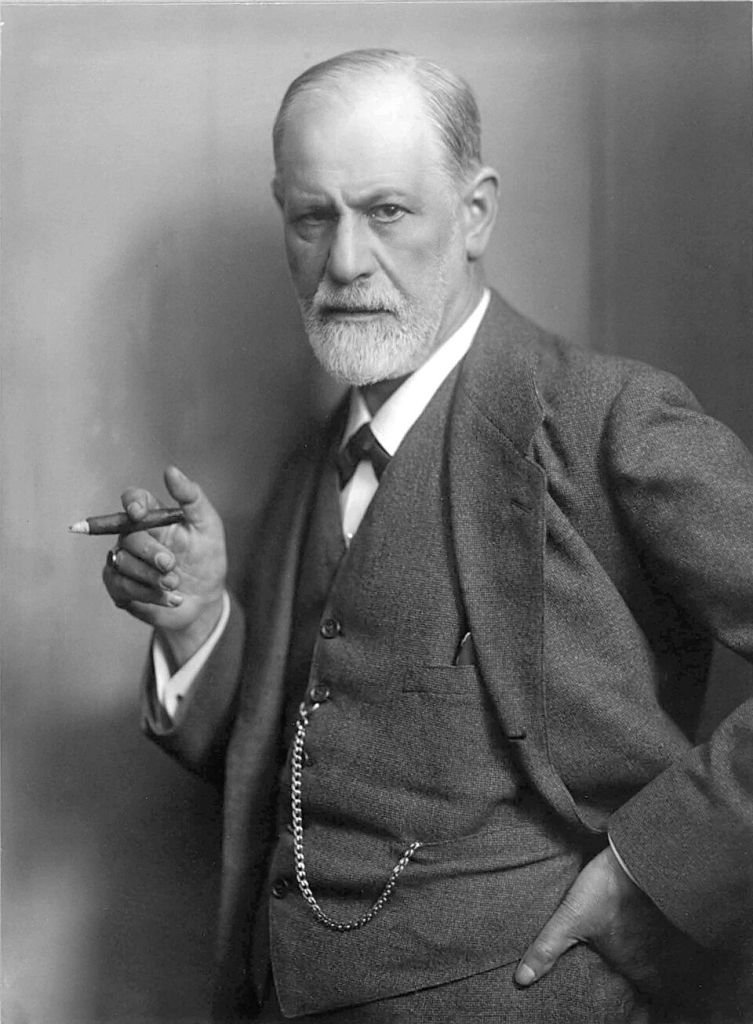
Sigmund Freud’s vision of life wasn’t one of peace or perfection. It was of honesty. Raw, difficult, illuminating honesty. He asked us not to chase after illusions, but to turn inward, to look at ourselves without flinching. To Freud, this was the only path to freedom. “Being entirely honest with oneself,” he said, “is a good exercise.” It’s also the hardest one.
Most of us spend our lives negotiating with forces inside us that we don’t fully understand. Freud called these forces the unconscious, and he believed they drive far more of our behavior than we realize. We like to imagine that we are rational creatures, steering our lives through will and intellect. But Freud reminded us that the mind is mostly hidden. “The mind,” he wrote, “is like an iceberg—it floats with one-seventh of its bulk above water.” What we see, what we know about ourselves, is just the surface. Beneath it is a world of memory, desire, trauma, and instinct—unseen but alive, shaping every decision, every relationship, every fear.
This may sound bleak at first, but for those who are awake to it, it becomes an invitation. Freud wasn’t trying to make life darker—he was trying to make us see. Because in seeing, we begin to heal. The act of becoming conscious is not an academic exercise; it is spiritual work. It demands that we slow down, listen inward, and examine what we are afraid to feel. That’s where growth begins—not in the avoidance of suffering, but in its conscious engagement.
Freud believed suffering was inevitable—not because he was pessimistic, but because he was honest. To be human is to feel deeply, to want what we cannot have, to love imperfectly, to face loss, guilt, longing, and contradiction. Life, in Freud’s view, is not a problem to be solved, but a tension to be lived through. And the task of the mature person is not to escape suffering, but to understand it. “One day, in retrospect,” he said, “the years of struggle will strike you as the most beautiful.” There is profound wisdom in this. The parts of life that break us open are the same parts that give us depth. Pain, when met with awareness, becomes a tool for transformation.
What Freud offered was not happiness in the shallow sense, but integration—a life in which we can hold our light and our shadow without denying either. He saw civilization as a necessary force, but one that comes at a cost. In order to live together, we must repress parts of ourselves: our aggression, our sexuality, our primal urges. This repression creates a conflict between our inner world and our outer life. It creates neurosis, tension, anxiety. But even this conflict, Freud believed, was valuable. It was the birthplace of art, ethics, and the human spirit. “From error to error,” he said, “one discovers the entire truth.”
In the quiet of self-exploration, we begin to understand that our greatest obstacles are often not the world outside us, but the resistances within. We defend against truth. We avoid our own depths. We cling to familiar pain rather than risk the uncertainty of freedom. Freud saw this clearly. “Most people do not really want freedom,” he wrote, “because freedom involves responsibility, and most people are frightened of responsibility.” But if we are willing to face that fear, to claim our inner life as our own, we come into contact with something sacred. We begin to awaken.
To live well, Freud believed, we must love and we must work. “Love and work,” he said, “are the cornerstones of our humanness.” Not as distractions from our inner struggle, but as the very arenas in which it unfolds. Love exposes our vulnerabilities. Work tests our ego. In both, we confront the limits of our control, the persistence of our fears, the need for meaning beyond mere survival. Freud did not ask us to escape these challenges. He asked us to show up for them with awareness.
Awakening, in Freud’s view, doesn’t mean rising above human nature. It means entering it more deeply, with our eyes open. It means holding space for contradiction—for the id and the superego, the desire and the guilt, the chaos and the order. In this way, he was not just a scientist of the mind; he was a guide toward inner wholeness. “Out of your vulnerabilities,” he said, “will come your strength.”
There is a quiet revolution in these words. Freud does not speak of conquering the self, but of understanding it. Not eliminating suffering, but learning to live with it gracefully. When we begin to accept that the human condition is not meant to be neat or painless, we also begin to stop resisting it. And in that space of surrender, something opens—clarity, compassion, courage. We are no longer running from ourselves. We are walking with ourselves, all the way in.
This is the gift of Freud’s vision—not comfort, but awakening. Not ease, but depth. He teaches us that maturity is not measured by how little we feel, but by how deeply we are willing to feel. That the goal is not to rid ourselves of conflict, but to become intimate with it. To explore our dreams, our fears, our wounds, and our longings—not to be free of them, but to be in relationship with them.
The life Freud points toward is not passive. It is conscious. It is a life that takes responsibility for its inner landscape, that stops blaming others and starts listening inward, that chooses presence over avoidance, and inquiry over denial. “The voice of the intellect is a soft one,” he said, “but it does not rest until it has gained a hearing.” That voice is always speaking. The question is whether we are ready to listen.
In the end, Freud’s invitation is simple but profound: Know yourself, fully. Love, despite the risk. Work, with honesty. Suffer, with awareness. And from the depth of your own psyche, awaken.
****
~Sigmund Freud (1856–1939) was an Austrian neurologist and the founder of psychoanalysis, a groundbreaking method for understanding the unconscious mind and treating mental illness. His theories on the id, ego, superego, repression, and dream interpretation revolutionized psychology and laid the foundation for modern psychotherapy. Freud’s work explored the deep conflicts within human nature, emphasizing that self-awareness and emotional insight are key to personal growth and healing.
Excellence Reporter 2025
Share this:

Categories: Wisdom of Life





 Excellence Reporter