
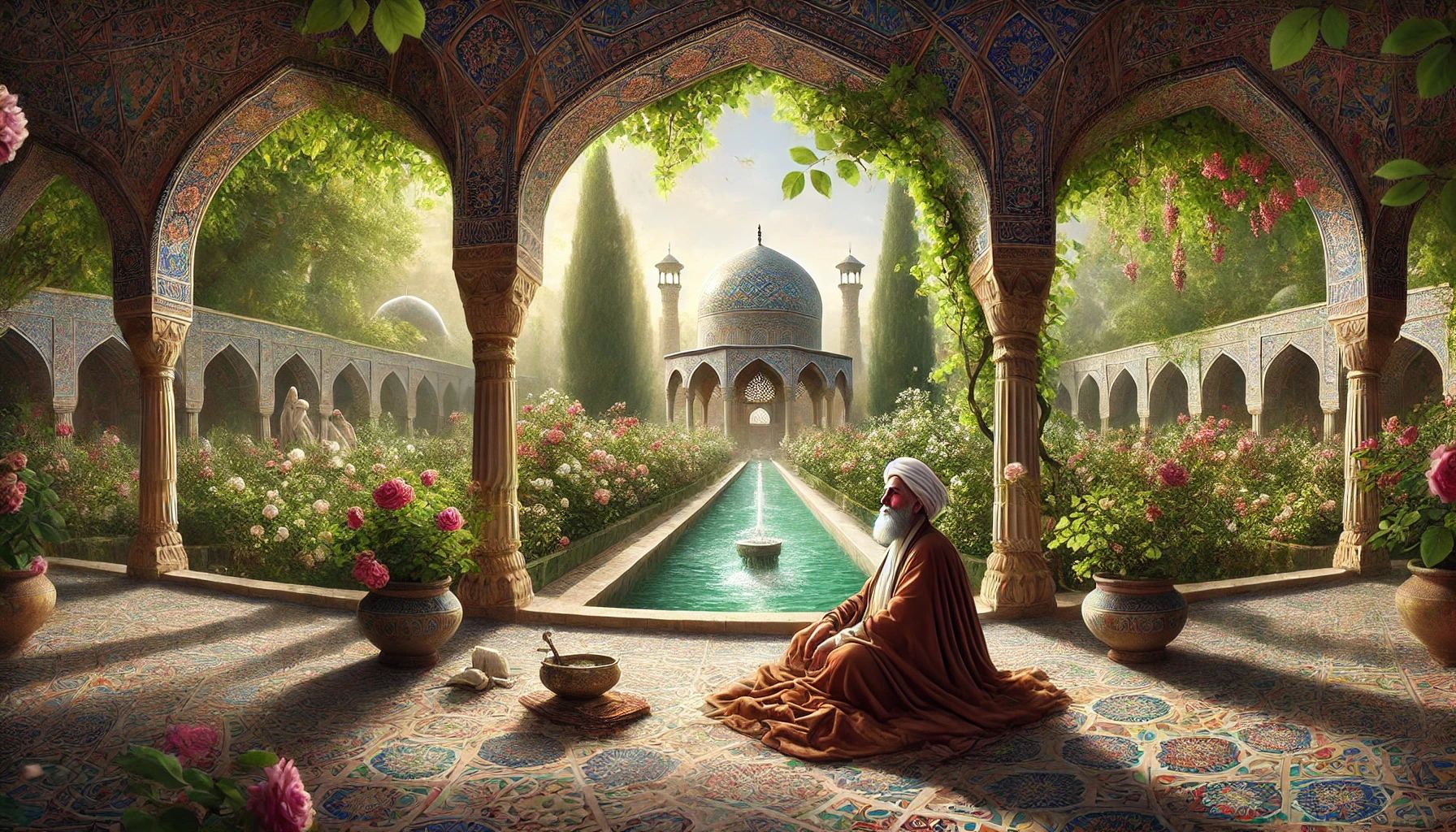
In the grand bazaar of Sufi poets, Hakim Sanai is both a mystic and a mirror. He doesn’t whisper gentle encouragements from the sidelines—he confronts, awakens, and demands transformation. Living in 11th-century Ghazni, present-day Afghanistan, Sanai wrote The Walled Garden of Truth (Hadiqat al-Haqiqa), a landmark of Persian Sufi literature that speaks across centuries to anyone brave enough to question illusion and pursue the Real.
Sanai didn’t care for surface-level comfort. His teachings about life rip through pretense and lead us to a raw, undeniable core: truth isn’t found outside, in possessions or accolades—it lives within, in stillness, silence, and surrender.
“You have no foot; yet you try to run. Be humble, and walk with the truth instead.”
The Illusion of the World
Sanai begins by demolishing our trust in appearances. To him, the world as most people live it is a mirage—a distraction of noise and glitter. We chase money, love, success, or validation, believing they will complete us. But Sanai sees these pursuits as a kind of madness.
“You think you are something; but in truth, you are nothing. It is your imagination that has made you drunk.”
He is not advocating nihilism. He’s pointing out that ego-driven life is hollow. Sanai insists that until we strip away the false self, we cannot begin to live. He compares life to a dream in which we are lost—mistaking shadows for substance. The only way out is through spiritual awakening, which begins with radical self-honesty.
The Call to Wake Up
One of Sanai’s most electrifying messages is that awakening is not reserved for saints or mystics in deserts—it’s available now, in the middle of your ordinary, messy life. But to awaken, you must shatter your pride, kill your attachments, and make room for something real.
“Die before you die, and be quiet. Die to everything you are not, so you may see what you truly are.”
This death is not physical. It’s the ego’s death—the crumbling of everything you thought defined you. Sanai sees this as liberation, not loss. When you let go of all the borrowed identities, what remains is pure awareness—a direct connection to the divine.
The Role of Love
Sanai’s vision of life is inseparable from love. But this isn’t sentimental or romantic love; it’s not about desire or possession. It’s the fierce, all-consuming love that dissolves boundaries between self and other. Love, for Sanai, is both the path and the destination.
“Where love comes, all other desires disappear. The fire of love burns away everything. Only God remains.”
This love is not chosen—it claims you. It reorders your priorities. It exposes every lie you’ve told yourself. When you are truly in love with the Divine, the material world begins to seem like a costume party you’re no longer interested in attending.
The Power of Silence
Sanai’s work overflows with language, but paradoxically, he teaches that truth is found not in words, but in silence. To know life deeply, we must go beyond intellect, beyond theology, beyond speech.
“The way is not in the sky. The way is in the heart. And the heart speaks only in silence.”
He warns that too much thinking clouds the soul. In our age of constant chatter—feeds, likes, arguments, information—Sanai’s call to silence is more relevant than ever. Only by retreating inward can we meet the source.
Surrender: The Ultimate Freedom
Perhaps the most liberating—but also most challenging—aspect of Sanai’s vision of life is his demand for surrender. Not resignation. Not defeat. But full, active surrender to a truth bigger than us.
“Put your cleverness aside. Let your heart speak. That is where God lives.”
To Sanai, surrender isn’t weakness—it’s the strength to stop pretending. It’s the freedom that comes from no longer needing to control the narrative. When we surrender, we open ourselves to divine intelligence that far exceeds our own.
He doesn’t promise comfort. He promises clarity. He doesn’t offer escape. He offers presence. In surrender, you finally come home—not to a perfect life, but to a real one.
The Inner Garden
Sanai’s masterpiece is titled The Walled Garden of Truth for a reason. The truth is a garden, lush and alive—but it is also walled, hidden from the outside world. The gate is inside you. You cannot break in through argument, ritual, or ambition. You must become still enough to hear its invitation.
“The treasure you seek lies within. Dig. Do not wander. Do not ask others for directions to your own soul.”
The garden isn’t in a book or a mosque or a theory. It’s behind your thoughts, beneath your fears, inside your breath. The irony is, it’s always been there. We just haven’t been quiet enough to notice.
You Were Born with Wings…
In a world obsessed with speed, productivity, and status, Sanai’s words are a thunderclap. He reminds us that life isn’t something we acquire—it’s something we awaken to. It doesn’t exist in the past or future, but in the sacred stillness of this moment.
He doesn’t promise happiness in the modern sense. He promises something deeper: truth. And with truth comes peace—not the peace of comfort, but the peace of alignment with the real.
“You were born with wings. Why prefer to crawl through life?”
Sanai challenges us to fly—not by doing more, but by becoming less. By dropping pretense. By shedding ego. By living nakedly, spiritually exposed to the light of what is.
Life, according to Hakim Sanai, is not a puzzle to solve but a veil to lift. The work is hard. The path is narrow. But the reward is incomparable: to be free, clear, and alive to truth.
He asks us not to believe blindly, but to wake up. Not to seek God in the heavens, but to become an instrument of divine presence here and now.
If you’re tired of chasing, if the surface no longer satisfies, if something deep inside you knows there is more—listen. The garden gate is open. The truth waits in silence.
“The way of the Sufi is to see what is real. Not to add, not to take away. Just to see—and bow.”
****
~Hakim Sanai (d. c. 1131) was a Persian Sufi poet, mystic, and philosopher best known for his monumental work The Walled Garden of Truth (Hadiqat al-Haqiqah), one of the earliest and most influential Sufi masterpieces in Persian literature. A former court poet turned spiritual seeker, Sanai abandoned a life of privilege to pursue divine truth. His poetry challenges ego, intellect, and illusion, urging the seeker toward inner awakening, love, and surrender. His teachings deeply influenced later mystics like Rumi, and his voice remains a timeless guide for those drawn to the path of the Real.
Excellence Reporter 2025
Share this:

Categories: Wisdom of Life




 Excellence Reporter