
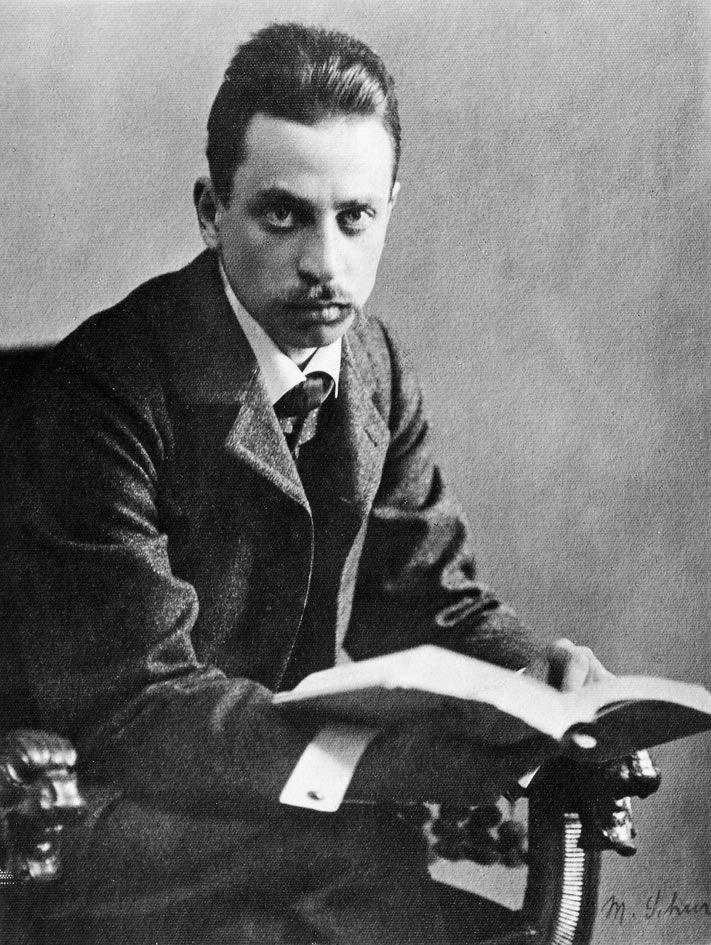
To live, truly live, is no small thing. It requires a fierce tenderness, a willingness to suffer beauty, and an openness to the mystery of our own becoming. Few writers captured this as intimately and as honestly as Rainer Maria Rilke. Through his poetry, letters, and prose, Rilke offered not instructions for living, but invitations—radical, luminous invitations—to stand fully inside our human experience. “Let everything happen to you: beauty and terror,” he wrote. “Just keep going. No feeling is final.” That is the heartbeat of his vision: to say yes to life in all its bewildering fullness.
Rilke did not preach answers. He distrusted them. Life, to him, was not a problem to be solved but a question to be lived. In his Letters to a Young Poet, he wrote:
“Be patient toward all that is unsolved in your heart and try to love the questions themselves.”
This is not passive waiting. This is active engagement with mystery. It is about bearing the uncertainty of life without collapsing into cynicism or despair. Rilke knew that life would not make itself plain on demand. It must be waited on, worked with, shaped and endured like a sculpture carving itself slowly into form. He compared this patient unfolding to the slow maturation of fruit ripening in silence.
At the core of Rilke’s philosophy of life is solitude—not loneliness, but solitude as a crucible. He saw aloneness not as an affliction but as a sacred condition.
“The only sadnesses that are dangerous and unhealthy are the ones that we carry around in public in order to drown them out with the noise,” he wrote. True living, Rilke believed, requires interiority. Not to escape the world, but to ground ourselves deeply enough that we can engage it with integrity.
In a world that rushes us toward superficiality and distraction, Rilke urges us inward. He insists that we attend to our depths, not just our surfaces.
“Go into yourself,” he writes. “Search for the reason that bids you write… this most inward and silent hour of the night.” Here, “writing” stands in for any calling—any act of creation, any movement of soul. What matters is that it emerges from within, not from the craving for praise or validation. For Rilke, authenticity is the only true compass. He wanted us to be “seized by something greater,” to lose our egos in the work of becoming.
But Rilke also understood that this process—the unfolding of the soul, the ripening of life—was inseparable from suffering. In fact, he saw pain not as an interruption of life but as one of its essential ingredients.
“Perhaps all the dragons in our lives are princesses who are only waiting to see us act, just once, with beauty and courage.”
This paradox—the idea that our pain may carry within it a hidden gift—is central to Rilke’s thought. It’s not that we should seek suffering. But when it comes, and it will, we must not reject it. We must meet it. Embrace it. Listen to what it is asking of us.
Rilke’s life was not free of hardship. He was often ill, frequently alone, sometimes impoverished. Yet he never grew bitter. Instead, he used the hardships as openings. He turned solitude into poetry. He turned grief into insight. He turned confusion into compassion. And he passed this courage on to us, not in doctrine, but in living language that breathes and burns.
One of his most profound insights is this: life itself is always in the making. There is no fixed self, no final arrival.
“We are not permitted to linger, not even with a star,” he wrote. To live is to move, to transform, to participate in a constant becoming. This can be terrifying, especially when we crave stability. But it can also be freeing. We are not stuck. We are not finished. We are always in motion.
Love, too, was for Rilke a practice of becoming. He rejected the idea of romantic fusion. He saw love not as merging with another, but as two solitudes that protect, border, and greet each other. In a time when love is often conflated with possession, Rilke offers a fierce clarity:
“Love consists in this: that two solitudes protect and touch and greet each other.”
To love, in Rilke’s view, is not to lose oneself in another, but to become more fully oneself in their presence. True love is spacious. It allows for freedom. It asks not for answers, but for reverence.
Perhaps one of Rilke’s most stirring insights is his belief in transformation through trust—trust in the invisible, the unknown, the unnameable forces that shape our lives.
“You must give birth to your images. They are the future waiting to be born.” To Rilke, creativity is not confined to artists. It is the fundamental gesture of being human: to shape something from our inner life and offer it to the world. Whether it is a poem, a relationship, a garden, or a life lived attentively, creation is our way of saying yes to the invisible currents of our becoming.
This trust requires faith—not in any religious sense, but in the sacredness of life itself.
“Live the questions now,” Rilke wrote. “Perhaps then, someday far in the future, you will gradually, without even noticing it, live your way into the answer.” There is immense hope in this. It means that we are not waiting for life to begin. We are already in it. We are already shaping the answer with every breath, every act of courage, every quiet hour spent listening to the world inside us.
Rilke’s writing is a mirror, a fire, a companion. It does not protect us from the wildness of life—it invites us into it. It challenges us to be fierce and tender, brave and soft. It tells us that being human is not a defect but a blessing, even in its ache. Especially in its ache.
If there is a final word from Rilke, it is this: live.
“Believe in a love that is being stored up for you like an inheritance,” he wrote, “and have faith that in this love there is a strength and a blessing so large that you can travel as far as you wish without having to step outside it.”
To live according to Rilke is not to seek perfection. It is to say yes—to the confusion, the solitude, the ache, the beauty. It is to meet life where it is, not where we wish it were. It is to trust the unseen. To protect our inner depths. To write, to love, to ask, and above all, to stay open.
In a world that fears uncertainty, Rilke gives us permission to live inside it. And that, more than anything, is what makes his voice timeless. He teaches us not how to escape life, but how to inhabit it—with reverence, with courage, and with the deep, silent joy of those who are becoming more fully themselves.
****
~Rainer Maria Rilke (1875–1926) was a Bohemian-Austrian poet, novelist, and mystic thinker best known for his deeply philosophical and lyrical works. His writings explore themes of solitude, love, death, and the inner life with unmatched sensitivity and depth. Celebrated works like Letters to a Young Poet, The Duino Elegies, and The Book of Hours have made him one of the most influential poets of the 20th century. Rilke’s timeless voice continues to inspire seekers, artists, and readers drawn to the spiritual and emotional dimensions of existence.
Excellence Reporter 2025
Share this:

Categories: Wisdom of Life




 Excellence Reporter