
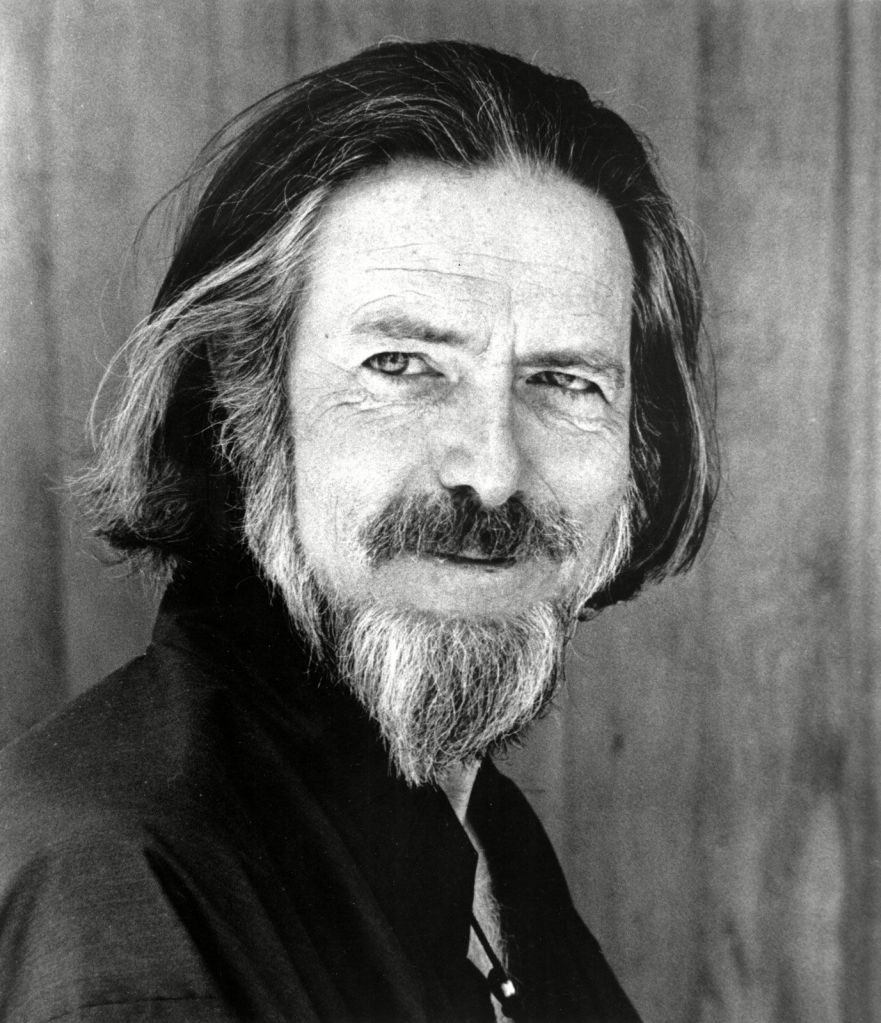
Alan Watts didn’t lecture—he unveiled. With the voice of a trickster sage and the clarity of a poet, he invited us not to figure life out, but to feel its pulse. He didn’t promise answers—he made peace with questions. To hear him speak was to suddenly see the invisible strings we dance by, to realize that much of what we take seriously is little more than theater. He peeled back the layers of modern life—its obsessions, its fears, its constant chase—and revealed something astonishingly simple: you’re already it. There’s nowhere to get to. There’s nothing missing.
Watts had the rare ability to make the profound feel intimate, and the cosmic feel personal. Drawing from Zen, Taoism, Hindu philosophy, and Western psychology, he created a kind of spiritual judo—flipping your worldview with a few carefully placed words. He wasn’t trying to convert you. He was trying to wake you up. He challenged the very premise of your struggle. What if the striving, the guilt, the endless becoming—what if all of that was based on a misperception? “We seldom realize, for example, that our most private thoughts and emotions are not actually our own. For we think in terms of languages and images which we did not invent, but which were given to us by our society.” Life, Watts believed, becomes free not when you conquer it, but when you stop pretending you’re separate from it.
Life Is Not a Journey—It’s a Dance
“The meaning of life is just to be alive. It is so plain and so obvious and so simple. And yet, everybody rushes around in a great panic as if it were necessary to achieve something beyond themselves.”
Watts cut through our obsession with goals and future achievements. He saw the Western mindset as tragically linear—always chasing some end point, whether it’s success, enlightenment, or happiness. But life, according to Watts, is not a race to be won or a riddle to be solved. It’s a dance. A musical thing. The point isn’t to get to the end, but to fully experience the flow.
He compared our culture’s fixation on progress to a symphony that rushes to its final note. What would be the point of a piece of music if the whole purpose was just to get to the last chord?
Watts reminds us that “this is the real secret of life—to be completely engaged with what you are doing in the here and now. And instead of calling it work, realize it is play.”
This isn’t permission to slack off—it’s an invitation to wake up. To feel life’s rhythm. To stop postponing your presence.
The Illusion of the Ego
At the heart of Watts’ philosophy is the idea that we are not who we think we are. We walk around trapped in a narrative constructed by the ego—a fragile fiction that says, “I am separate. I am in control. I must become something more.”
But Watts peels back the illusion. He challenges: “You are an aperture through which the universe is looking at and exploring itself.” That changes everything.
You’re not a disconnected self navigating a cold, external world. You are the world, made conscious. The ego is like a wave believing it is separate from the ocean. But the wave is the ocean, just in motion.
When you stop identifying with the ego and start seeing yourself as part of the unfolding universe, fear loses its grip. There is no isolated “I” that has to defend itself. There is just the vast mystery, and you are it.
Embrace the Mystery
Watts wasn’t interested in giving answers. He was more interested in helping you live the question. The deeper truths, he believed, can’t be pinned down like specimens. They can only be felt, known in the gut, glimpsed in silence or laughter.
“The more a thing tends to be permanent, the more it tends to be lifeless.”
He saw how our culture clings to certainty, control, permanence. But life is change. Everything is moving, shifting, morphing. Trying to fix it in place is like trying to nail down a river.
So what do we do?
We let go. We learn to trust the flow.
He wrote, “To have faith is to trust yourself to the water. When you swim you don’t grab hold of the water, because if you do you will sink and drown. Instead you relax, and float.”
Watts doesn’t say this is easy. It takes courage to surrender—to step into the unknown without clinging. But it’s the only way to truly live. Life is not a problem to be solved. It’s a mystery to be lived.
You Are It
Perhaps his most famous phrase is deceptively simple: “You are it.”
That’s not self-help hype. That’s a metaphysical bomb. Watts is saying the divine, the sacred, the totality—it’s not out there. It’s you, right here. You don’t need to climb a mountain, join a religion, or purify your soul to connect with the universe. You are the universe, awake for a little while, pretending to be a person.
There’s nothing to attain. No final enlightenment to grasp. That’s the trick. The more you chase it, the more you affirm your separation from it.
Watts said, “Trying to define yourself is like trying to bite your own teeth.”
Let that sink in.
We spend so much energy trying to “find ourselves,” as if we’re hidden under a rock. But the self we’re looking for is the one doing the looking. And once you get that—really get it—everything shifts.
You realize the game has always been about seeing clearly, not achieving more.
The Cosmic Game
Life, in Watts’ view, is a kind of divine game of hide-and-seek. Consciousness pretends to forget itself, just so it can rediscover itself in a thousand forms. That’s what you are. That’s what we all are. Sparks of the infinite, playing this wild, temporary game of form and identity.
“You didn’t come into this world. You came out of it, like a wave from the ocean. You are not a stranger here.”
This isn’t a metaphor—it’s reality. You are made of stars. You’re a product of billions of years of cosmic evolution. You are nature, expressing itself as a human being.
When you understand that, your perspective changes. The suffering, the struggle, the beauty, the boredom—it’s all part of the play. It’s not meaningless. But it’s also not serious in the way we make it. It’s sacred because it’s fleeting.
“Man suffers only because he takes seriously what the gods made for fun.”
So laugh more. Be kind. Let go of the script. Live like it’s all music and you are the dancer, not the one trying to control the rhythm.
Live Now. There Is No Later.
In all of Watts’ teachings, there is one underlying theme that pulses loud and clear: Now is all you ever have.
The past is memory. The future is fantasy. Life always unfolds in the present moment.
“This is the real secret of life—to be fully engaged with what you are doing in the here and now.”
We keep waiting for the perfect moment, the right conditions, the green light. But this is it. This messy, imperfect, beautiful now—that’s where it all happens.
Watts doesn’t ask us to reject goals or plans, but to stop living only for them. Because if you’re always chasing “someday,” you’ll miss the only time that’s real.
Right now.
Final Words
Alan Watts didn’t offer answers. He offered a revolution in perception. He showed us that life isn’t a test—it’s an invitation. Not to solve, but to participate. Not to win, but to play. Not to escape, but to awaken.
If there’s one truth to carry with you, it might be this:
“You are the universe experiencing itself, momentarily caught in the illusion of being a person.”
Live accordingly.
****
~Alan Watts (1915–1973) was a British philosopher, writer, and speaker best known for translating Eastern philosophy—especially Zen Buddhism, Taoism, and Hinduism—into language Western audiences could grasp. With wit, clarity, and a deep sense of wonder, he challenged conventional thinking and invited people to see life not as a problem to be solved, but as a game to be played. His work continues to inspire seekers of wisdom, presence, and inner freedom.
Excellence Reporter 2025
Share this:

Categories: Wisdom of Life




 Excellence Reporter
Are you trying to find the best books about dream states’ spiritual power? Learn about the profound insights of visionary author Kenneth K. Gray, who examines the holy bridge that connects consciousness and the divine. Whether you’re looking for healing, clarity, or a closer relationship with your…
LikeLike