
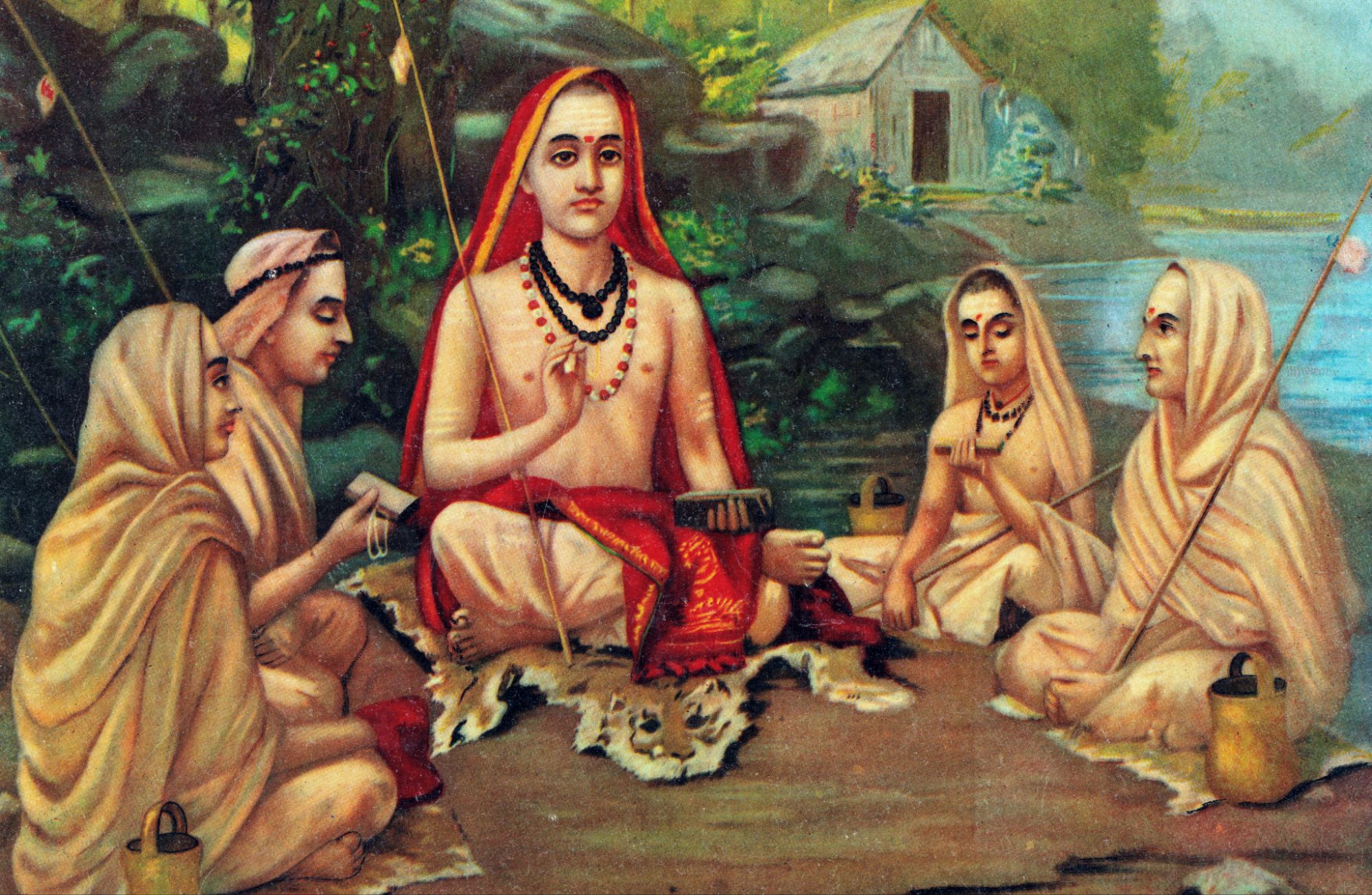
In a world obsessed with achieving, accumulating, and becoming, the ancient wisdom of Adi Shankaracharya slices through illusion with clarity, simplicity, and power. Born in 8th-century India, Adi Shankara was not just a philosopher; he was a spiritual revolutionary. By age 32, he had revived Advaita Vedanta—the doctrine of non-duality—and left behind a body of work that continues to shake the foundations of identity, purpose, and reality itself.
To understand life through Shankara’s eyes is to stand at the edge of all our assumptions and step into what he called the Atman, the Self—unchanging, eternal, infinite. His message is not merely metaphysical. It’s intensely practical. It’s not about withdrawing from life, but seeing it clearly for what it is: a play of appearances over a silent truth.
“Brahma satyam jagan mithya, jivo brahmaiva na aparah.”
“Brahman (the Absolute) is real; the world is unreal. The individual self is none other than Brahman.”
The Illusion We Call Life
Shankara begins with a provocation: what we call “life” is largely maya—illusion. This doesn’t mean the world is fake, but that our perception of it is distorted. We see separation where there is unity. We see permanence in what is fleeting. We attach our sense of self to the body, to status, to success, and suffer when these shift or fall away.
According to Shankara, life becomes suffering only because we mistake the impermanent for the real. Birth, death, joy, pain—they swirl in the realm of maya. The wise one sees this and does not cling.
“Punarapi jananam punarapi maranam, punarapi janani jathare shayanam…”
“Again and again one is born, again and again one dies, and again and again one sleeps in the mother’s womb.”– Bhaja Govindam
This cycle of rebirth and suffering—samsara—is not broken by action, but by knowledge. Not by doing more, but by seeing clearly.
The Power of Discrimination
At the core of Shankara’s teaching is viveka—the ability to discriminate between the real and the unreal. This isn’t cynicism; it’s clarity. It’s the power to ask, “What am I, really?” And to keep asking until all masks fall away.
To practice viveka is to look at life not as a series of achievements, but as an opportunity to awaken. We begin to notice how we identify with thoughts, roles, desires—and how each one of these is temporary.
“Who are you? Whose son are you? From where have you come? O fool, think of the truth: in truth, you are born of ignorance.”
– Bhaja Govindam
For Shankara, spiritual life doesn’t begin with rituals or beliefs. It begins with direct inquiry: “Who am I?” Peel back every label—male, female, parent, worker, friend, even ‘seeker’—and what remains?
You Are That
The answer, for Shankara, is simple and profound: Tat Tvam Asi—You are That. You are not the body. Not the mind. Not your story. You are pure consciousness—Brahman—untouched by time, space, or circumstance.
This is not a poetic metaphor. It is the highest realization, the end of seeking. And it’s accessible not after death, but now, in this very moment, once ignorance is removed.
“Chidananda rupah shivoham shivoham.”
“I am the form of consciousness and bliss. I am Shiva. I am Shiva.”
– Nirvana Shatakam
These are not the words of a man escaping the world. They are the words of someone who has seen through it. Once you realize you are not the waves, but the ocean itself, fear dissolves. Grasping ends. Life becomes lighter, freer, more peaceful—not because it has changed, but because you have.
Detachment Is Not Withdrawal
One of the biggest misconceptions about Advaita is that it advocates withdrawal from life. Shankara never says that. What he urges is detachment—not from people or duties, but from ego, expectation, and identification.
You can live fully, love deeply, serve compassionately—and still know that the Self is untouched by any of it. True detachment is not coldness. It’s freedom.
“Yogarato va bhogarato va sangarato va sangaviheenah,
Yasy brahmani ramate chittam nandati nandati nandatyeva.”“Whether engaged in yoga or pleasure, in society or solitude—if the mind revels in Brahman, it rejoices, it rejoices, it rejoices indeed.”
– Bhaja Govindam
This is the radical beauty of Shankara’s vision. You don’t need to renounce the world. You need to see it for what it is—and know what you are beyond it.
The Path Forward: Knowledge, Not Belief
For Shankara, salvation doesn’t come from blind faith. It comes from jnana—self-knowledge. Not reading, not rituals, but direct insight into the nature of the Self.
He offers a three-step method:
- Shravana – Listening to the truth from a qualified teacher or scripture.
- Manana – Reflecting on it deeply, removing doubts.
- Nididhyasana – Meditating and abiding in that truth until it becomes your lived reality.
This path requires courage. It demands that you look at life not as a collection of events, but as a mirror to the eternal. It asks you to stop chasing and start being.
The Call of the Eternal
In a time when life feels more fragmented than ever, Adi Shankara’s voice cuts through the noise:
“Seek Govinda, Seek Govinda, Seek Govinda, O fool!
When the time comes for departure, grammar rules will not save you.”
– Bhaja Govindam
This isn’t anti-intellectualism. It’s a reminder: when death comes, knowledge, status, wealth—none of it will matter. Only Self-knowledge will.
To live according to Shankara is to begin now—not tomorrow, not when life settles down. Now is the only moment that exists. And in it lies everything.
In the End, Freedom
What is the fruit of this path? Not escape. Not ecstasy. But freedom—from fear, from bondage, from suffering.
You still live, love, lose, and learn—but you are not shaken. You know yourself to be the screen, not the movie; the light, not the shadows.
This is not abstraction. It is the deepest kind of inspiration: that who you are is already whole, already free, already divine.
All that remains is to realize it.
Conclusion
Adi Shankara’s teachings are not about renouncing life, but about understanding it. He calls us not to reject the world, but to wake up from the dream of separateness. Life, seen clearly, is a sacred opportunity—not to become something, but to realize what you’ve always been.
You are not broken. You are not lost. You are That.
“Aham Brahmasmi.”
“I am Brahman.”
Not in theory. In truth.
****
~Adi Shankara (8th century CE) was an Indian philosopher and spiritual reformer who consolidated the doctrine of Advaita Vedanta—non-dualism. He taught that the true Self (Atman) is identical to the ultimate reality (Brahman), and that liberation comes through knowledge, not ritual. Despite living only 32 years, his commentaries, poems, and teachings revived Hindu thought and continue to influence spiritual seekers worldwide.
©Excellence Reporter 2025
Share this:

Categories: Buddhism






 Excellence Reporter