
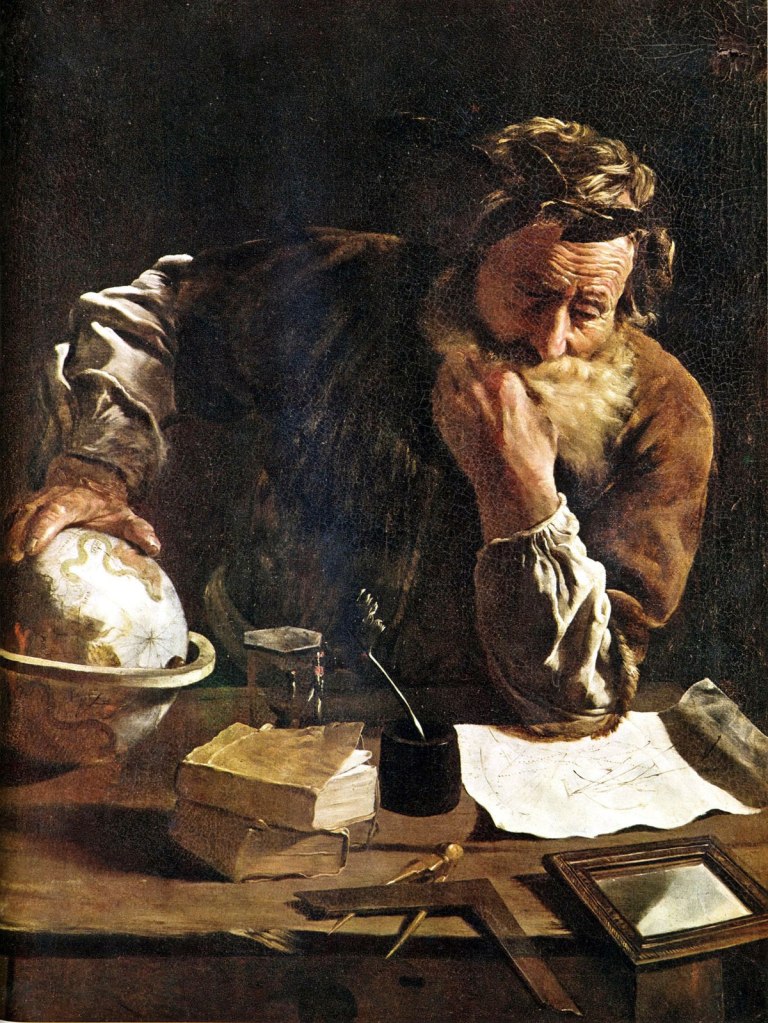
Archimedes of Syracuse, one of the greatest minds of the ancient world, is best remembered for his contributions to mathematics, physics, and engineering. But behind the theorems, the levers, and the pulleys, lies a deeper philosophy—one that speaks not only to the structure of the universe but also to the essence of life. His ideas offer more than academic insight; they point to a profound way of seeing the world and ourselves.
“Give me a place to stand, and I will move the Earth.”
This is perhaps Archimedes’ most famous quote. On the surface, it’s a bold claim about leverage, a fundamental principle in mechanics. But read it again, not as an engineer, but as a human being. The quote becomes a declaration of potential: that with the right fulcrum, any person—any life—can become a force of transformation.
The Fulcrum of Purpose
Archimedes believed in the power of simplicity. His inventions were not driven by complexity but by elegant solutions. The lever, the screw, the pulley—each harnessed the laws of nature to achieve more with less.
The same can be said of life. In a world that often confuses motion for meaning, Archimedes reminds us that it’s not about doing more, but about understanding where to apply force. The question becomes: What is your fulcrum? What principle, passion, or truth do you stand on that allows you to move your world?
Life without direction exhausts itself. But life with a well-chosen point of leverage—one core purpose—can do extraordinary things. Whether it’s a cause, a calling, or a quiet commitment, finding that fulcrum can change everything.
“Eureka!”: The Joy of Discovery
The story is well-known: Archimedes steps into a bath, watches the water rise, realizes the principle of buoyancy, and shouts “Eureka!”—“I have found it!”—running naked through the streets in his excitement.
It’s a funny image, but the message is powerful. To live like Archimedes is to seek—and celebrate—discovery. Not just scientific discovery, but personal discovery: those sudden flashes of insight when something true about the world, or about ourselves, becomes clear.
Life isn’t about having all the answers. It’s about staying curious enough to keep asking better questions. Archimedes didn’t find joy in being right—he found joy in finding. That’s a radical shift. It means life is not a problem to solve, but a mystery to explore.
“Eureka” moments don’t always come in bathtubs. Sometimes they come in heartbreak, in failure, in stillness. But they come—if we stay open, if we keep looking.
The Balance Between Logic and Wonder
Archimedes was rigorous. He proved things. He didn’t just trust intuition—he built upon it with logic and precision. And yet, his work reveals a deep reverence for the beauty of the universe.
There’s a lesson here about balance. Modern life often swings between extremes: cold rationality or blind emotion, hard science or vague spirituality. Archimedes embodied both: the mind of a mathematician with the soul of a philosopher.
To live like him is to embrace both sides. Use reason to navigate reality, but don’t lose the sense of awe. The more he uncovered the laws of nature, the more wonder he found in them. That’s a good model for us, too. As we learn, grow, and achieve, we shouldn’t become numb. We should be more awake.
Legacy in Silence
Archimedes didn’t seek fame. He wasn’t chasing legacy. In fact, he asked that his tomb be marked with a simple diagram of a sphere within a cylinder, representing his favorite geometric discovery.
There’s humility in that. A reminder that what we leave behind isn’t what we boast about, but what we build quietly, carefully, and often anonymously. The true measure of a life isn’t always what’s seen. It’s the impact we have, sometimes long after we’re gone.
“Do not disturb my circles.”
These were reportedly Archimedes’ last words. As the story goes, he was drawing geometric figures in the sand when a Roman soldier came to arrest him. Absorbed in thought, he didn’t want to be interrupted. The soldier killed him on the spot.
It’s a tragic ending—but also an image of total devotion. Even in the face of death, Archimedes was immersed in his work, his curiosity, his sense of order. “Do not disturb my circles” isn’t just a plea—it’s a way of living. It’s about protecting your space, your time, your attention. It’s about guarding what matters most.
In our age of constant interruption, those words feel more relevant than ever. What are your circles? What sacred things do you draw in the sand, hoping the world won’t disturb?
The Stillness Beneath the Genius
Archimedes didn’t live in a lab. He lived in a city under siege. He lived in the chaos of history, politics, and war. Yet his mind found calm. He found order where others saw disorder. He looked deeper. Beneath the noise, he found patterns. Beneath the surface, he found laws.
That’s perhaps the most important lesson. Life is noisy. It’s full of pressure, deadlines, injustice, suffering. But somewhere beneath it all is something stable. Something you can stand on. Something you can use to move the world.
So, what does it mean to live like Archimedes?
It means:
- Find your fulcrum. Know where to stand.
- Stay curious. Keep discovering.
- Embrace both logic and wonder.
- Do the work for its own sake, not for applause.
- Protect your inner space.
- Look for patterns beneath the noise.
And maybe most of all, it means believing that with the right focus, even you—right where you are—can move the Earth.
Because the laws Archimedes uncovered weren’t just about machines. They were about potential. And that potential still lives in each of us.
“Give me a place to stand, and I will move the Earth.” That place may not be glamorous. It may not even be obvious. But it’s there, waiting for you.
Have you found it yet?
***
~Archimedes of Syracuse (c. 287 – c. 212 BC) was an Ancient Greek mathematician, physicist, engineer, astronomer, and inventor from the ancient city of Syracuse in Sicily. Although few details of his life are known, based on his surviving work, he is considered one of the leading scientists in classical antiquity, and one of the greatest mathematicians of all time. Archimedes anticipated modern calculus and analysis by applying the concept of the infinitesimals and the method of exhaustion to derive and rigorously prove many geometrical theorems, including the area of a circle, the surface area and volume of a sphere, the area of an ellipse, the area under a parabola, the volume of a segment of a paraboloid of revolution, the volume of a segment of a hyperboloid of revolution, and the area of a spiral.
©Excellence Reporter 2025
Share this:

Categories: Wisdom of Life






 Excellence Reporter