
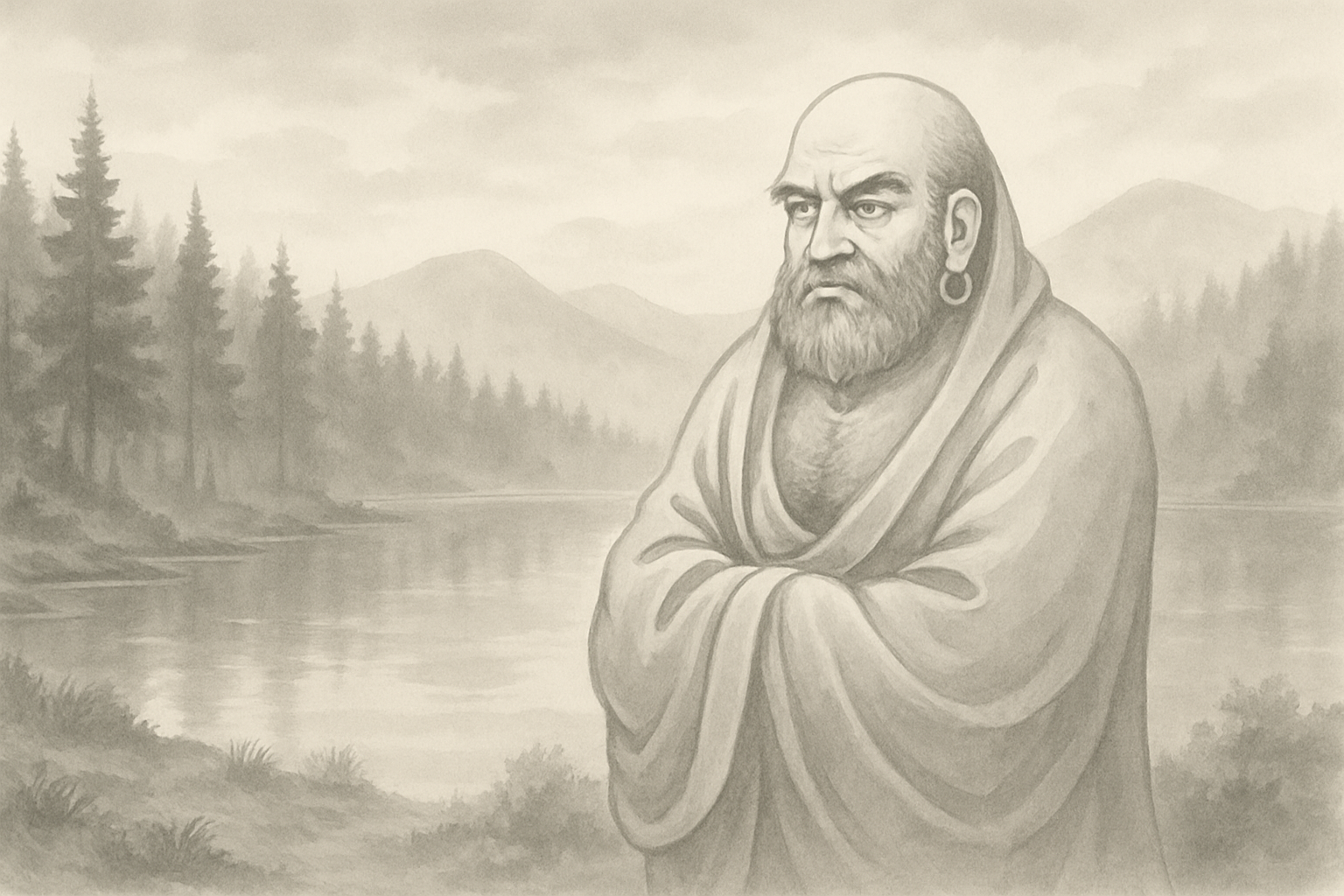
Bodhidharma, the 5th or 6th-century Indian monk who brought Chan Buddhism (which became Zen) to China, wasn’t interested in metaphysics, rituals, or theological debates. He was a man of silence and direct experience. To him, life wasn’t something to theorize about—it was something to wake up from.
When we look at life through Bodhidharma’s eyes, we see something raw, stripped of illusions. His view wasn’t grim—it was liberating. He saw life not as a journey of acquiring more, but of letting go. Not as a search for meaning, but as the end of seeking itself.
“To seek is to suffer. To seek nothing is bliss.”
This is where Bodhidharma’s teachings cut through. In a world that thrives on seeking—success, fame, validation—he taught the courage of stillness. He taught that the mind we rely on to navigate life is the very thing clouding it. The core of his message? Wake up. Not in theory, but in being.
The Illusion of the Self
Bodhidharma was relentless in dismantling the ego. He didn’t entertain identity, stories, or self-concepts. When Emperor Wu of Liang asked what merit he had earned by building temples and supporting monks, Bodhidharma famously replied:
“No merit whatsoever.”
To Bodhidharma, acts rooted in ego—even spiritual ones—are still traps. The self that tries to be good, enlightened, or virtuous is still caught in illusion. He wasn’t dismissing kindness, but pointing to something deeper: the emptiness of the self.
He wrote:
“A Buddha is someone who finds freedom in good fortune and bad.”
True liberation isn’t about controlling life—it’s about being untouched by it. The self that reacts to gain or loss, praise or blame, pleasure or pain—that’s the illusion. Bodhidharma’s life points us inward, to see that behind this ever-changing stream of experiences, there’s no fixed “I” at all.
The Practice of Wall-Gazing
One of the most iconic stories about Bodhidharma is that he spent nine years meditating in front of a wall. No distractions. No texts. Just raw attention.
This wasn’t about doing nothing—it was about meeting reality without filters. “Wall-gazing” wasn’t literal, necessarily—it was a metaphor for facing the wall of one’s mind, still and unwavering. He said:
“The mind is the root from which all things grow. If you can understand the mind, everything else is included.”
To understand life, he taught, understand the mind. Not analyze it, not improve it—see through it. Sit with it long enough, and you’ll see its tricks, its fears, its relentless grasping. And eventually, you’ll see it’s not what you are.
The Direct Transmission
Bodhidharma brought a radical message to China: enlightenment doesn’t come from scriptures, rituals, or logic—it comes from direct experience. He described Zen as:
“A special transmission outside the scriptures; Not dependent on words or letters; Directly pointing to the human mind; Seeing one’s nature and becoming Buddha.”
This was a revolution. It cut through religious bureaucracy. You didn’t need to be a scholar or a priest to wake up. You just needed to look—deeply, honestly, without turning away. Bodhidharma wasn’t anti-scripture, but he refused to let words replace insight.
In life, we often cling to ideas: about who we are, how the world works, what will make us happy. Bodhidharma invites us to drop it all. To go beyond thought and taste life directly—raw, unsweetened, real.
Life Is Suffering—and That’s Okay
Unlike the modern obsession with happiness, Bodhidharma didn’t sugarcoat reality. Life, he taught, is suffering—not as punishment, but as a fact. Our bodies age, our loved ones die, our minds chase illusions. And still, we resist it all.
He said:
“All know the way, but few actually walk it.”
Knowing about suffering, reading about impermanence, nodding at spiritual ideas—that’s easy. Living it, facing it without running—that’s rare. But it’s here, in this unfiltered presence, that freedom begins.
He didn’t teach escape. He taught engagement—without clinging. He taught us to sit with the ache, the joy, the fear—without trying to possess or push them away. Life doesn’t need to be controlled. It needs to be seen.
The Courage to Let Go
One of Bodhidharma’s most powerful messages is that liberation isn’t found by gaining something new. It’s found by letting go. This sounds simple, but it’s radical. Most of life is built around acquiring: knowledge, possessions, status. Bodhidharma says—drop it.
“Not creating delusions is enlightenment.”
This is the heart of his teaching. Enlightenment isn’t some mystical peak. It’s the end of delusion. And delusion starts with identification—with “me,” “mine,” and “I want.”
He taught that when you stop creating stories, stop fueling cravings, stop resisting what is—what’s left is clear, silent, awake. That’s what he meant by Buddha-nature. Not a being, not a god, but this ever-present awareness under all noise.
A Mirror for Our Lives
Bodhidharma holds up a mirror. Not to judge us, but to show us what we’re doing. We grasp, we avoid, we pretend. He simply says: stop. Be still. Look. Don’t add anything. What you seek is already here.
“This mind is the Buddha.”
What does that mean? That you, as you are—beneath the layers of fear, pride, thought, identity—are already what you’re looking for. Life, then, isn’t about becoming something. It’s about uncovering what’s never been lost.
Living Bodhidharma’s Wisdom Today
In our world of distractions, performance, and endless self-improvement, Bodhidharma’s path is radical. But it’s more relevant than ever. He doesn’t offer comfort—he offers truth. He doesn’t promise success—he offers freedom.
To live his wisdom today:
- Practice stillness. Sit. Breathe. Watch the mind.
- Let go of stories. You don’t need to define or defend yourself.
- Don’t seek outside. The answer isn’t out there—it’s in your direct experience.
- Face suffering directly. Don’t run from it. Meet it with awareness.
- Trust silence. Insight often arises not through thinking, but through presence.
Final Word
Bodhidharma doesn’t give us an easy life. He gives us a real one. He strips away everything false until only truth remains—not a doctrine, but a lived clarity. In a world obsessed with becoming, he teaches being. In a world of noise, he points to silence. In a world that fears emptiness, he shows its peace.
If we’re willing to stop running, stop seeking, stop pretending—we might find what Bodhidharma saw sitting before that wall: that nothing is missing. That life, just as it is, when met without illusion, is already awake.
***
~Bodhidharma was a 5th–6th century Indian monk and the legendary founder of Zen (Chan) Buddhism in China. Known for his fierce simplicity and emphasis on direct experience over scripture, he taught that true enlightenment comes from seeing one’s own nature and letting go of illusion. His influence shaped the core of Zen practice: meditation, self-inquiry, and radical honesty.
©Excellence Reporter 2025





 Excellence Reporter