
“The fear of death follows from the fear of life.
A man who lives fully is prepared to die at any time.”
“Wilderness is not a luxury but a necessity of the human spirit, and as vital to our lives as water and good bread. A civilization which destroys what little remains of the wild, the spare, the original, is cutting itself off from its origins and betraying the principle of civilization itself.”
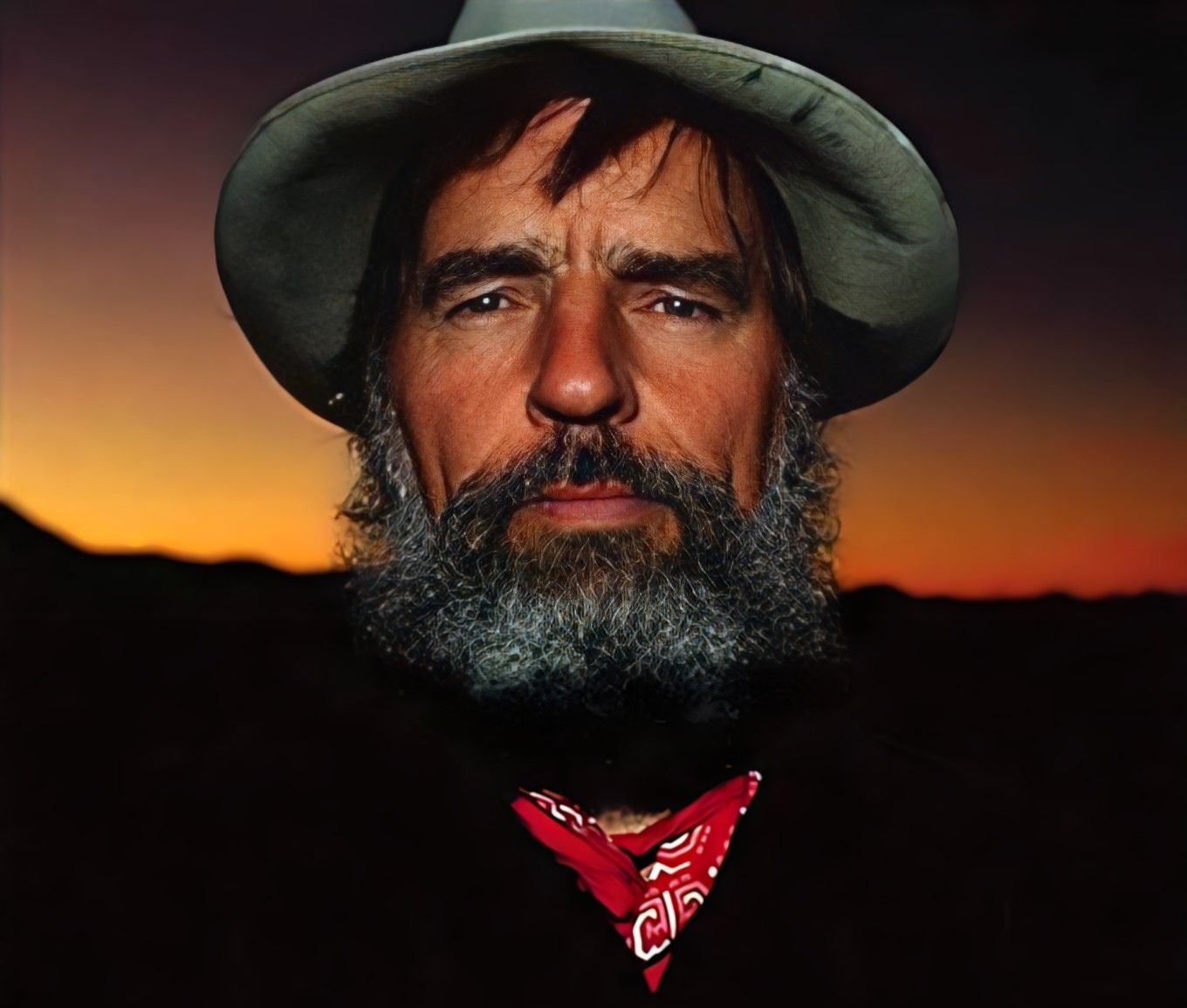
Edward Abbey never asked for approval. He didn’t try to make his ideas digestible or polite. What he did do was live with raw intensity, write with defiant honesty, and leave behind a blueprint for living that still kicks hard against the artificial rhythms of modern life. Abbey saw through the smog—literal and figurative—and championed a life rooted in wildness, solitude, rebellion, and fierce clarity.
To understand life through Abbey’s eyes is to strip away the plastic and digital gloss of society and get your hands dirty in the red earth of the desert. It’s to seek truth, not comfort; freedom, not approval; wilderness, not civilization. And in doing so, to truly live.
Wildness is Necessity, Not Luxury
Abbey’s most famous work, Desert Solitaire, isn’t just a love letter to the Utah desert—it’s a manifesto. “Wilderness is not a luxury,” he wrote. “But a necessity of the human spirit.” In Abbey’s worldview, the wild wasn’t a weekend escape or a postcard backdrop. It was the proving ground of the soul. Without wilderness, he believed, we lose a vital connection to who we are.
The desert, in its brutal honesty, revealed things to Abbey that society often obscured. Where the city teaches conformity, the desert demands adaptation. Where modern culture coddles, wilderness tests. In nature, nothing is wasted, and nothing lies. “The earth, like the sun, like the air, belongs to everyone—and to no one.”
For Abbey, life stripped to its essence—firelight, stars, water, stone—wasn’t primitive, it was pure. And maybe that’s the first lesson: life isn’t found in accumulation, but in shedding what isn’t essential. In trading comfort for clarity.
Rebellion is a Form of Integrity
Abbey didn’t trust authority, institutions, or any system that put profit over the planet. “Growth for the sake of growth,” he warned, “is the ideology of the cancer cell.” That quote alone sums up his blistering critique of industrial civilization. For him, modern life had become a parody of progress: cities sprawling like metastasized tumors, people tethered to machines, nature reduced to scenery behind a windshield.
His answer wasn’t blind rage—it was radical clarity. He urged people to wake up. To question. To resist. “A patriot must always be ready to defend his country against his government.” That wasn’t just bravado—it was a demand for conscience.
In Abbey’s version of life, rebellion isn’t reckless. It’s moral. A refusal to go numb. A refusal to look away from the destruction of the land, the commodification of beauty, the erosion of the individual spirit. “Sentiment without action is the ruin of the soul,” he wrote. So act. Speak. Fight when it matters.
Solitude is Sacred
Most of Abbey’s iconic work was born out of solitude. He wasn’t a hermit, but he understood the value of being alone in nature. “I find that contemplating the natural world my most reliable form of prayer.” For him, solitude wasn’t loneliness—it was liberation. The absence of noise. Of roles. Of demands. In the silence of the canyonlands, a person could actually hear themselves think.
In our hyper-connected world, his insistence on solitude feels almost revolutionary. He challenges us to turn everything off. To go outside alone. To sleep under the stars. To learn how to be with ourselves without distraction. “You can’t study the darkness by flooding it with light.”
In solitude, you confront your mind—its wildness, its fears, its truth. That confrontation, Abbey believed, is essential to being fully alive.
Love the Land, and It Will Teach You
Abbey was no romantic in the sappy sense. He loved the land like you love something that has both raised and wrecked you. His devotion wasn’t sentimental—it was visceral. “The love of wilderness is more than a hunger for what is always beyond reach; it is also an expression of loyalty to the earth.”
That loyalty came with responsibility. He didn’t just admire beauty—he fought for it. From opposing dam projects that would drown canyons to mocking the absurdity of “scenic development” (i.e., paving paradise), Abbey lived what he preached. He encouraged people to go outside and to get mad when that outside was under threat.
Life, in Abbey’s eyes, meant throwing yourself into something bigger. Loving the land meant defending it. That’s not politics—that’s principle.
Life Should Be Lived With Teeth Bared
Abbey’s humor was sharp, his metaphors sharper. He saw absurdity everywhere—in bureaucracy, in blind obedience, in consumer culture. But his cynicism was a mask for deep passion. “Do not burn yourselves out,” he wrote. “Be as I am—a reluctant enthusiast…a part-time crusader, a half-hearted fanatic.”
He knew that taking life too seriously is as foolish as not taking it seriously enough. Joy mattered. Laughter mattered. Chopping wood, drinking beer under the stars, loving wildly—all of it mattered. Life wasn’t meant to be sterile or controlled. It was meant to be felt.
He hated uniformity. He championed contradictions. He was a wild romantic and a harsh realist. A loner who stirred the masses. A conservationist who littered beer cans in protest. He reminds us that to be fully human is to be messy, passionate, flawed—and awake.
A Call to Live More Honestly
So what does life look like through the lens of Edward Abbey?
It looks like putting your boots in the dirt and turning off your phone. It looks like questioning everything you’re told to accept. It looks like solitude, protest, beauty, dirt, danger, laughter, fire, water, silence, rage, and reverence. It looks like waking up every day and asking: What’s real? What matters? What am I willing to fight for?
Abbey won’t hold your hand. He won’t make you feel safe. But he will dare you to live honestly.
“I took the other road,” he once wrote. “And it turned out to be a dead end. But I enjoyed the walk.”
That’s the essence of his philosophy. Don’t chase safety. Chase meaning. Even if the road is hard, even if it ends. Because what matters is how you walk it.
Final Word
Edward Abbey didn’t offer a roadmap to life. He offered a compass—and it points straight to the wild. Not just the wilderness out there, but the wilderness in here. In the heart. In the gut. In that part of us that still remembers what it means to be free, to be whole, to be alive.
Let the desert speak to you. Let the rivers teach you. Let your own life burn bright with purpose. And when in doubt, remember Abbey’s creed:
“May your trails be crooked, winding, lonesome, dangerous, leading to the most amazing view.”
That’s not just how he saw life. That’s how he lived it. And how, if we dare, we can live it too.
****
~Edward Abbey (1927–1989) was an American author, essayist, and environmental activist best known for his passionate defense of the natural world and his fierce criticism of modern civilization. Born in Pennsylvania and later rooted in the deserts of the American Southwest, Abbey wrote influential works like Desert Solitaire and The Monkey Wrench Gang, blending poetic observation, biting satire, and radical environmental philosophy. A self-described “desert anarchist,” Abbey inspired generations to think critically, live boldly, and protect the wild places that define the soul of the land.
Excellence Reporter 2025
Share this:

Categories: Nature, Wisdom of Life




 Excellence Reporter