
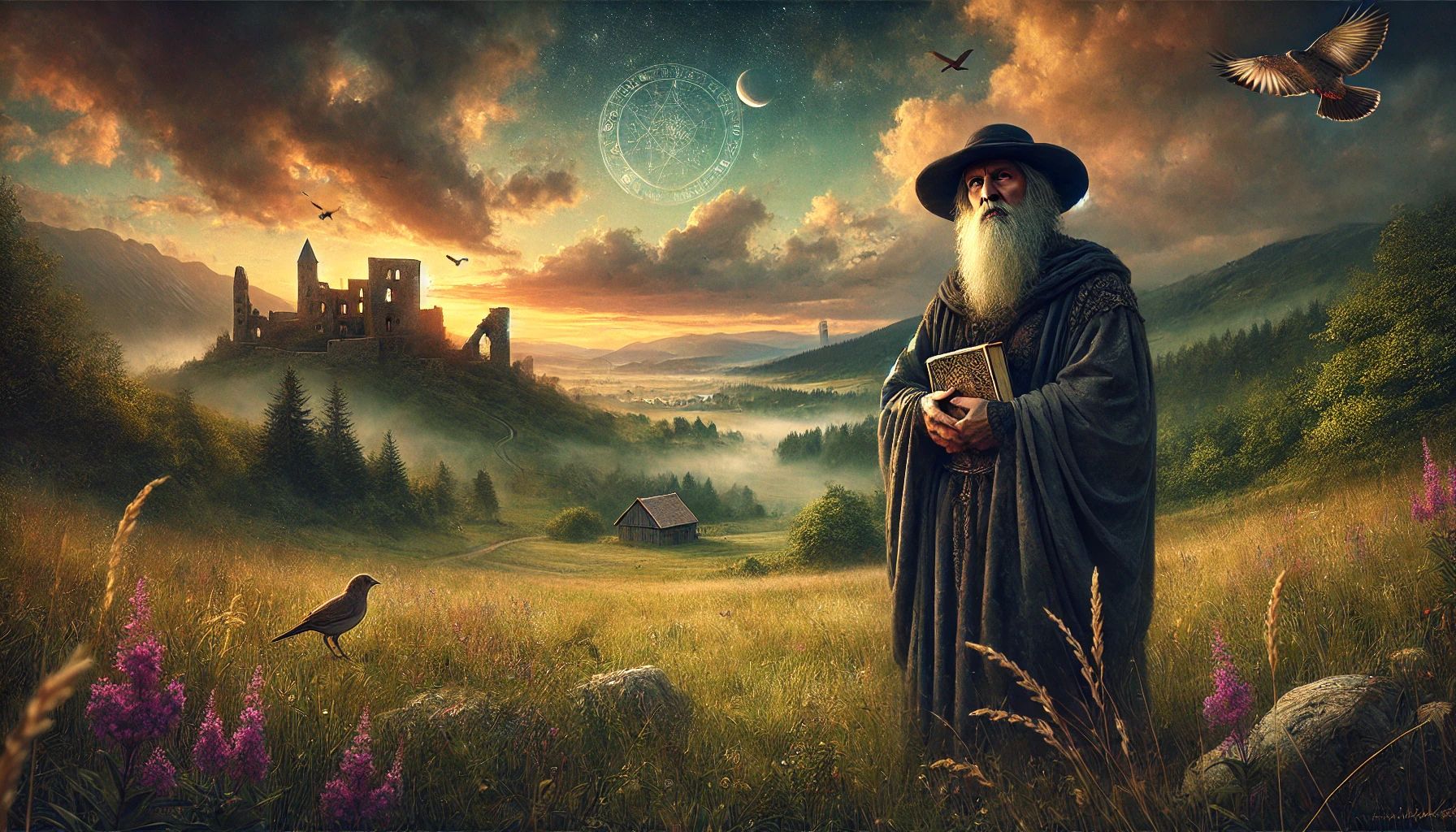
Michel de Nostredame, better known as Nostradamus, is best remembered for his cryptic quatrains and eerily accurate prophecies. But beyond the headlines and predictions of catastrophe lies a deeper, richer philosophy—one that reflects on the nature of time, fate, and the human soul’s search for meaning.
Strip away the drama, and you’ll find a man obsessed not with doom, but with the grand architecture of life itself. Nostradamus was a physician, an astrologer, and a seeker. He didn’t just predict events; he grappled with the biggest questions: Why are we here? What governs our destiny? Can we shape our future, or are we bound to repeat the cycles of the past?
These questions, still pressing today, form the backbone of his legacy—not just as a prophet, but as a philosopher of life.
The Clockwork of Time and Fate
Nostradamus believed time wasn’t random. He saw it as a repeating pattern, like the stars that guided his calculations. “All things are bound together in cycles,” he hinted in his poetic, coded verses. This wasn’t fatalism. It was a call to understand the rhythms of life.
In Les Prophéties, he writes:
“The great man will be struck down in the day by a thunderbolt,
An evil deed foretold by the bearer of a petition.”
Yes, it’s often read as a political prediction. But look deeper: there’s a warning about ignoring signs, about brushing aside what seems insignificant. Life sends signals. If we’re blind to them, consequences follow. To Nostradamus, fate isn’t a dictator—it’s a mirror. If history repeats, it’s because humanity repeats its mistakes.
He invites us not to fear the future, but to wake up. His message isn’t, you can’t change fate, but rather, you can only change fate by seeing it for what it is.
A Soul in Search of Balance
For Nostradamus, life was a tightrope walk between divine will and human folly. He believed the cosmos had a plan, but also that individuals had the power—and the responsibility—to align themselves with that plan.
In one of his letters, he wrote:
“Events that approach are not to be feared, but understood. The stars incline, they do not bind.”
This is one of his most powerful insights. The future isn’t carved in stone. The stars may hint, but they don’t command. In today’s world, where so much feels out of control, that thought hits home. Nostradamus reminds us that fear isn’t wisdom. Life asks for awareness, not surrender.
Suffering as a Teacher
Few know that Nostradamus lost his wife and children to the plague. It shattered him. But from that grief came a deeper perspective. He continued healing others. He kept writing. He dove into the mystical, not to escape his pain, but to make sense of it.
He once said:
“Through suffering, the soul awakens.”
That’s not just poetic—it’s brutally true. In his worldview, suffering wasn’t punishment; it was a crucible. The soul doesn’t evolve through ease. It grows by wrestling with loss, uncertainty, and mortality. His life was evidence of this: a man broken by tragedy who rebuilt himself through purpose.
To live well, according to Nostradamus, is not to avoid pain—but to transform it.
Symbols, Silence, and the Inner World
Much of Nostradamus’s writing is enigmatic—full of riddles, symbolism, and metaphor. Critics say he was obscure on purpose. Supporters say he was hiding truths from those who weren’t ready.
Both might be right.
But there’s another reason: life itself is symbolic. Things don’t always say what they mean. Meaning is layered. What seems trivial can be sacred. What looks like an ending might be the beginning of something else.
Nostradamus teaches us to listen to life like we listen to poetry—not with the ears, but with the heart.
He wrote:
“Hidden truths reside beneath veiled words. Only the wise will hear the silence between lines.”
Profound lives aren’t always loud. Insight doesn’t shout. Wisdom whispers, and the wise learn to listen. Nostradamus believed that life spoke in dreams, signs, and synchronicities. If we want to understand life, we must train ourselves to read it.
Legacy Beyond Prediction
It’s easy to reduce Nostradamus to a sensationalist oracle. But to do so is to miss the real power of his work. He wasn’t just talking about empires rising and falling. He was talking about us—what it means to live in uncertain times, to feel small in a vast world, and to reach for something higher anyway.
One of his most stirring lines says:
“When the columns of man tremble, only the soul stands firm.”
That’s the kind of timeless wisdom we need now. In a world shaken by crisis, noise, and division, it’s easy to lose center. But Nostradamus urges us to return to the soul—to remember we’re part of something greater, but never powerless.
What Nostradamus Really Offers Us
Not fear. Not fatalism. Not mysticism for the sake of spectacle. What he offers is perspective. He pushes us to zoom out, to think long-term, to see the links between past, present, and future.
His work is a kind of soul mirror—showing us both our shadows and our potential.
He tells us:
- The future can be glimpsed, not controlled.
- Pain is a portal, not a prison.
- Symbols are truths in disguise.
- Silence holds the deepest answers.
- We are not victims of fate, but apprentices of wisdom.
A Final Thought
Nostradamus died in 1566. But his voice still echoes, not because he nailed some predictions, but because he captured the eternal tension of being human: the longing to understand, to transcend, to belong.
He looked at life and saw not chaos, but pattern. Not despair, but evolution.
And perhaps his most enduring message is this:
“To know the future, study the soul. To know the soul, live with intention.”
In a world racing toward tomorrow, Nostradamus reminds us that the true secret to life isn’t prediction—it’s presence.
Not to escape fate, but to live awake within it.
****
~Michel de Nostredame, known as Nostradamus (1503–1566), was a French astrologer, physician, and seer best known for his book Les Prophéties, a collection of cryptic quatrains believed to predict future events. Drawing on his knowledge of history, medicine, astronomy, and the occult, he crafted poetic verses that have fascinated readers for centuries. Beyond prophecy, Nostradamus was a deep thinker on fate, the soul, and the cycles of human life.
Excellence Reporter 2025
Share this:

Categories: Wisdom of Life





 Excellence Reporter