
“Lock up Russell’s writings for a thousand years until man is ready for them.”
— attributed to Nikola Tesla —
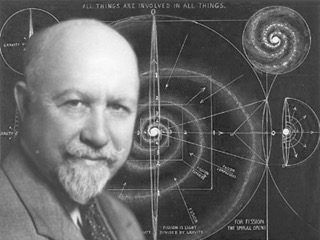
Walter Russell wasn’t your typical philosopher or scientist. He was a visionary who defied categories—artist, sculptor, architect, musician, and mystic. But more than that, he was a man convinced that the universe operated by universal laws of balance, rhythm, and purpose—and that each of us is part of that system, not separate from it.
At the core of Russell’s philosophy is this idea: we are creators, not victims. Life is not random, and neither are we. He wrote, “You were born to create. You are an electric wave of thinking mind, recording the thoughts of the Universal One.”
Let’s break down how Russell saw life, and how his ideas can help us live more inspired, purposeful, and peaceful lives.
You Are a Genius—Yes, You.
Russell believed genius wasn’t rare. He saw it as natural and dormant in all people. His famous statement, “Mediocrity is self-inflicted. Genius is self-bestowed,” flips the common narrative on its head. He argued that every person has within them the same creative power that drives the universe. The only difference is awareness and effort.
This means that the limits we often accept—what we’re good at, what we’re “meant” to do—are usually imagined. For Russell, anyone can tap into genius by aligning with universal principles and practicing inner stillness, creativity, and self-discipline.
Don’t wait to be given permission to be great. Act like you already are, and the rest will catch up.
Balance Is the Law of the Universe
Russell’s cosmology was built on one key law: balance. Everything in the universe, from atoms to galaxies, operates through rhythmic interchange—what he called “giving and regiving.” Life, he said, is not about taking or competing, but giving in balance with receiving.
“Rhythm is the universal heartbeat of nature,” he wrote. When we violate rhythm—by overworking, over-consuming, or overreacting—we fall out of sync. Stress, failure, and chaos follow. But when we respect rhythm, life flows.
This applies to relationships, health, work, and thought. Give too much without rest, and burnout hits. Take too much without giving, and imbalance takes its toll.
Learn to feel the rhythm of your own life. Push and rest. Give and receive. Create and reflect. Keep the balance.
The Stillness Within Is Your Power
A recurring theme in Russell’s writing is the importance of inner stillness. He said that the source of all knowledge and creativity is found in silence, in the quiet communion with what he called the Universal One, or God.
“God will work with you, but not for you,” he said. You have to show up. You have to listen. In a noisy world, this might sound impossible, but Russell insisted the answers we’re looking for don’t come from the outside—they come from within.
He advised daily periods of stillness, not as escape, but as contact with truth. From that contact, clarity and inspiration would flow.
You already have the answers you seek—but you have to get quiet enough to hear them.
The Universe Is Not a Machine—It’s a Mirror
Russell rejected the cold, mechanical view of the universe popular in his day. He didn’t see matter as inert or separate from mind. He saw the entire cosmos as conscious, alive, and governed by intelligence.
“The universe is a thought of God,” he wrote. That means it’s not random. It responds. It mirrors what we put into it. If you live with fear, stress, or anger, life mirrors that. But if you live with purpose, gratitude, and joy, the world reflects it back.
In other words, we’re not spectators in life—we’re participants, co-creators. What we think, feel, and do has real power.
Live as though the universe is listening—because it is.
Work Is Sacred When It’s Inspired
Russell didn’t believe in toiling just for money or status. To him, all work—whether sculpting or farming—was sacred when done with passion and purpose. He saw his own artistic work as a form of prayer.
“Work that is inspired from within is not labor—it is growth,” he wrote. He believed we should each find our purpose and give it everything we have, not just for success, but because it’s what keeps us alive inside.
He worked constantly, creating a lifetime’s worth of art, science, and philosophy—but he always emphasized that inspired work was the key, not busyness for its own sake.
Find the work that lights you up, and make it your offering to the world.
Love Is the Power Behind It All
At the root of Russell’s vision was love—not sentimental or emotional, but universal love. He saw love as the creative force of the universe. It’s what holds everything together, what drives us to give, what keeps us connected.
He didn’t preach dogma. He lived what he called “cosmic consciousness”—the awareness that all things are one. “God is Light—and God is Love,” he said. This wasn’t metaphor. It was literal. He believed light itself was the universal language of creation—and that to live in love is to live in the flow of that light.
Choose love. Not just in romance, but in thought, speech, and action. It’s the highest intelligence.
Walter Russell’s life and philosophy challenge us to think bigger—not just about the universe, but about ourselves. He didn’t see people as weak or broken. He saw them as divine sparks of intelligence, capable of incredible things.
To live according to Russell is to live with awareness: of rhythm, balance, stillness, creativity, and love. It’s to stop reacting and start creating. It’s to remember that the power behind galaxies is also within you.
So pause. Breathe. Look inside.
As Russell said, “There is no limitation set upon man; he sets it himself.”
***
~Walter Russell (1871–1963) was an American polymath—an accomplished artist, sculptor, musician, architect, author, and self-taught scientist. He’s best known for his work on the unity of science and spirituality, proposing a dynamic universe based on light, rhythm, and balance. Without formal scientific training, he developed a “new concept of the universe” that challenged conventional physics. He also co-founded the University of Science and Philosophy with his wife Lao Russell to teach principles of universal law, creativity, and conscious living. His writings continue to inspire seekers of knowledge, truth, and inner power.
©Excellence Reporter 2025
Share this:

Categories: Wisdom of Life




 Excellence Reporter
1 reply »