
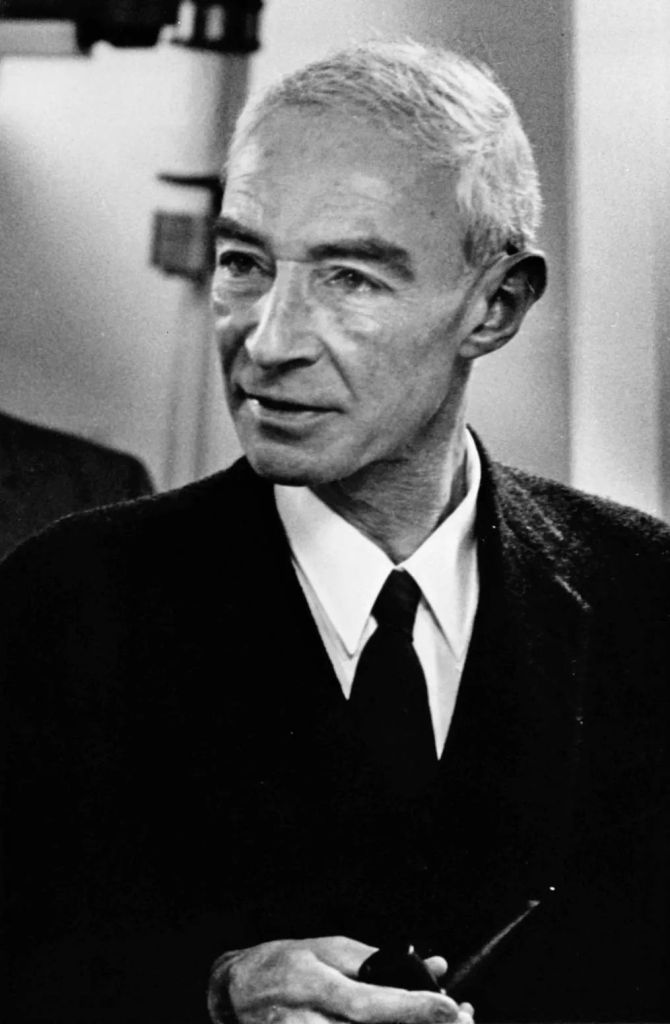
J. Robert Oppenheimer, the physicist who led the Manhattan Project and helped create the atomic bomb, is often remembered for a single line—“Now I am become Death, the destroyer of worlds.” Quoting the Bhagavad Gita as he watched the first successful nuclear test, Oppenheimer became a symbol of scientific brilliance entangled with moral crisis. But there was much more to his view of life than that haunting phrase. His reflections on science, responsibility, ambition, and the human condition reveal a man grappling with the deepest paradoxes of existence.
To understand life through Oppenheimer’s eyes is to look unflinchingly at complexity—intellectual, ethical, and emotional. It is to recognize the limits of human power even at the peak of human achievement. It is to wrestle with the consequences of knowledge, the fragility of civilization, and the loneliness of those who see too far ahead.
A Life of Contradictions
Oppenheimer lived at the intersection of many identities: Jewish but drawn to Hindu philosophy; a theoretical physicist fluent in poetry; a patriot who befriended communists; a hero turned pariah. He was not a man of easy categories. His life was not a clean narrative arc—it was a loop, a web, a paradox.
“I carry no weight on my conscience,” he once said in public about his role in building the bomb. Yet privately, and in later years, his remorse was evident. He told President Truman, “Mr. President, I feel I have blood on my hands.” Truman dismissed him coldly. But the point wasn’t politics. The point was conscience.
Oppenheimer teaches us that being human means carrying contradictions. Wanting to know and fearing what we’ll do with the knowledge. Wanting to help and still causing harm. Life, to him, wasn’t about purity or perfection—it was about owning our complexity, and not looking away from it.
The Mind and the Moral
Oppenheimer was a towering intellect, but he never believed intelligence alone could save us. He saw early on that progress in knowledge does not equal progress in wisdom. “In some sort of crude sense which no vulgarity, no humor, no overstatement can quite extinguish,” he said, “the physicists have known sin; and this is a knowledge which they cannot lose.”
That word—sin—was carefully chosen. It marked a turning point in the moral history of science. Before Oppenheimer, physicists often saw their work as a pure search for truth. After him, they had to confront its consequences.
Oppenheimer reminds us that brilliance without humility is dangerous. And that no amount of technical knowledge exempts us from ethical responsibility. In a world flooded with information, this may be one of his most urgent lessons: that the future will be shaped not by how much we know, but by what we choose to do with what we know.
The Cost of Vision
Oppenheimer had a rare kind of foresight. He saw not only the birth of the atomic age but the beginning of an entirely new world order. And like many visionaries, he paid for it.
After World War II, Oppenheimer became a public advocate for arms control and international cooperation. He opposed the development of the hydrogen bomb. For this, he was labeled disloyal during the Red Scare, stripped of his security clearance, and humiliated in a government hearing. The man once celebrated as a national hero was cast out.
But he remained dignified. “The optimist thinks this is the best of all possible worlds,” he said, quoting Voltaire. “The pessimist fears it is true.” Oppenheimer saw clearly that the world was flawed, that power corrupts, and that reason alone would not guide nations. Yet he did not stop thinking, speaking, or searching for meaning.
From Oppenheimer we learn that clarity comes at a cost. Seeing the truth is not always rewarded. But he also shows us that wisdom is not about winning—it’s about witnessing. It’s about staying engaged even when the world turns its back.
The Inner World
For all his public impact, Oppenheimer’s reflections on life were deeply personal. He once said, “There are children playing in the street who could solve some of my top problems in physics, because they have modes of sensory perception that I lost long ago.” This wasn’t just about science—it was about the loss of innocence, of joy, of wonder.
He studied Sanskrit to read the Bhagavad Gita in the original. He loved French poetry and Dutch painting. He was fascinated by mysticism, and yet insisted on clarity of thought. He was at home in both the lab and the library, in mathematics and metaphysics.
His inner life was vast. And that’s another quiet teaching from Oppenheimer: life is not just action—it’s also reflection. The depth of a person cannot be measured by accomplishments alone, but by the size of their questions.
What Remains
In the end, Oppenheimer’s life poses a question more than it gives an answer: What do we do with our power? Not just technological power, but the power to choose, to act, to influence others, to shape the future.
He did not resolve the tension between brilliance and morality. He was the tension. He embodied it. And in doing so, he forces us to confront it ourselves.
Perhaps this is what makes Oppenheimer’s life so compelling—not because he was heroic or villainous, but because he was real. Intellectually fierce, morally wounded, emotionally complex. He tried to live with eyes wide open. He tried to hold together reason and reverence. And even when he failed, his effort was profound.
If there’s one message that comes through his words and life, it’s this: to be human is to know more than we can handle, to feel more than we can say, and to carry on anyway—thoughtfully, humbly, and awake.
A final word from the man himself:
“In the material sciences these are and have been, and are most surely likely to continue to be, heroic days. But that is not the end of the story.”
Oppenheimer understood that no achievement, no weapon, no theory is ever the whole story. The story is human. The story is moral. The story is what we choose to do next.
***
~J. Robert Oppenheimer (1904–1967) was an American theoretical physicist best known as the scientific director of the Manhattan Project, which developed the first atomic bomb. Often called the “father of the atomic bomb,” he later became a vocal advocate for arms control and warned against the dangers of unchecked scientific power. Brilliant, complex, and deeply philosophical, Oppenheimer remains a symbol of both human ingenuity and moral reckoning in the modern age.
©Excellence Reporter 2025
Share this:

Categories: Wisdom of Life







 Excellence Reporter