
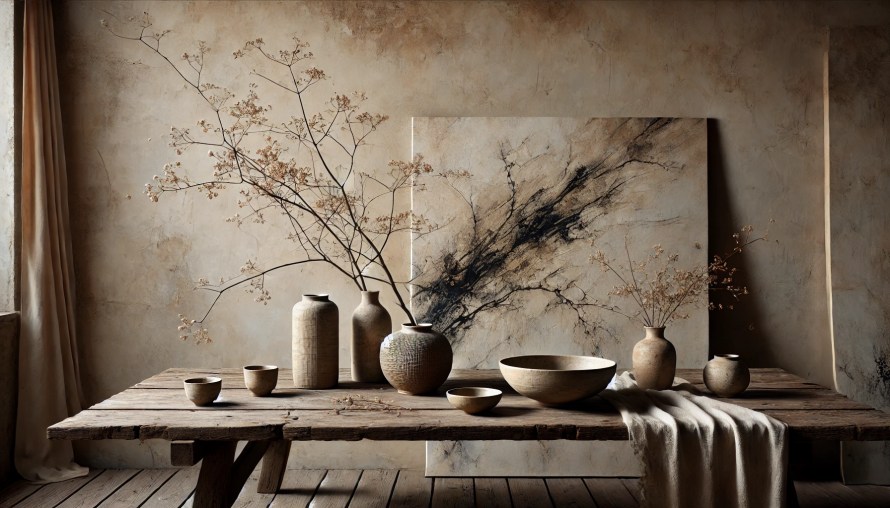
Imagine stepping into a Japanese Wabi-Sabi living room. The space is designed with a balance of minimalism and warmth, creating an atmosphere of serenity and quiet elegance. At the center, a low, round wooden table with visible natural cracks and texture grounds the space, serving as both a functional piece and an artistic statement. Surrounding it is a modular, earth-toned sofa, generously cushioned to invite relaxation. The arrangement is informal yet intentional, encouraging a sense of ease and connection. The wall behind the sofa features a striking large-scale hanging scroll depicting an ancient bonsai tree—symbolizing resilience, balance, and the passage of time. To the left, floor-to-ceiling glass windows allow natural light to pour in, seamlessly blending the indoor and outdoor environments. The view of lush greenery beyond acts as a living artwork, reinforcing a sense of harmony with nature. Light, sheer curtains soften the edges, offering a gentle contrast to the concrete elements. In this room, time seems to slow, allowing one to fully engage with the present moment—a true reflection of Ikigai and the art of mindful living.
This living space is not just designed for aesthetics; it is a retreat for contemplation, a sanctuary of simplicity, where each element serves a purpose. There is no excess, no clutter—just an atmosphere of quiet elegance, where every object has meaning and every detail breathes simplicity. This is the power of aesthetic simplicity: it clears the mind, soothes the soul, and allows us to focus on what truly matters. Ikigai teaches that when we simplify our lives—our thoughts, our spaces, our daily routines—we create room for clarity, balance, and lasting peace.
In Japan, the philosophy of “Ma” refers to the space between things—between objects, between words in a conversation, between the moments of life. It is an appreciation for silence, for stillness, for the power of what is left unsaid or undone. Simplicity is not about having less; it is about creating space for more meaning, more awareness, and more peace.
Yet, many people today live in a constant state of excess—too much information, too many obligations, too many distractions. They fill their schedules to the brim, accumulate possessions they rarely use, and consume more than they need. But instead of feeling fulfilled, they feel overwhelmed, burdened by the very things they believed would bring them happiness. Those who live with Ikigai understand that life’s deepest joys are often found in simplicity—in a quiet morning, a single cup of tea, an uncluttered home, a mind free of unnecessary worries.
A powerful example of this wisdom is found in the Japanese tea ceremony, or “Sadō” (茶道), the Way of Tea. Every movement is deliberate, every object carefully chosen. The utensils are simple, the gestures slow, the focus entirely on the present moment. Nothing is rushed, nothing is excessive—yet, in its simplicity, the tea ceremony holds profound beauty and meaning. This reminds us that when we strip away distractions, we can fully experience the richness of life.
Many people believe that success is measured by how much they own, how much they accomplish, how much they consume. They chase after more, believing that happiness is found in accumulation. But Ikigai teaches that clarity and peace come not from having more, but from needing less. When we let go of the nonessential—both physically and mentally—we gain a sense of freedom, lightness, and focus.
The people of Okinawa, known for their long and joyful lives, embody this principle. Their homes are modest, their possessions few, yet they live with abundance—not of things, but of connection, purpose, and gratitude. They prioritize what truly matters: health, relationships, time spent in nature, and meaningful work. This simplicity allows them to live with less stress and more presence.
If you ever feel overwhelmed, ask yourself: What can I let go of? What truly adds value to my life, and what is just excess noise? These questions help shift focus from consumption to clarity, from busyness to balance.
A beautiful analogy for simplicity is found in the Japanese art of Haiku poetry. In just a few lines, Haiku captures the essence of a moment, using minimal words to express deep emotion. The beauty of Haiku lies not in complexity, but in its ability to distill life into something pure and profound. In the same way, when we simplify our lives, we create space for deeper experiences, for greater appreciation, for peace.
There is a Japanese saying: “Shibumi” (渋味)—”Simple elegance.” It reminds us that life’s beauty is often found in quiet, subtle things. A well-worn wooden table, a single blooming flower, a shared meal prepared with care—these simple moments, when noticed and appreciated, bring a deep sense of fulfillment.
Ikigai teaches that simplicity is not about doing without—it is about making room for what matters. When we clear away clutter, whether physical or mental, we gain focus, clarity, and peace. And in that space, we find that happiness was never in having more—it was always in being fully present with what is already here.
©Excellere Reporter 2025





 Excellence Reporter