
Photographer Alina Desyatnichenko traveled to one of Russia’s most mystical regions, the Baikal area, where she conducted brief interviews with local shamans about their initiation into shamanism.
Understanding the spirituality of the Baikal Buryats is not just difficult—it is exceptionally challenging. The dominant official religions in the region are Orthodoxy and Buddhism, but because these faiths were historically introduced to local communities in an often forceful manner, many people accepted them only outwardly while remaining devoted to ancestral and clan-based spiritual traditions, particularly shamanism. Historically, shamanism is a deeply personal and non-public religious practice, primarily serving the needs of a specific clan, tribe, or ulus (a regional community). As a result, even at larger communal prayer gatherings (taiglanas), shamans from different tribes often struggle to find common ground.
The Buryat cosmology consists of three interconnected worlds. The upper world is home to the Tenger deities, with the highest among them being Huhe Munhe Tenger, the Creator and Sky Father. The lower world is ruled by the fearsome Lord Erlik Khan. The middle world is where humans reside.
Besides the Tenger deities, numerous other spirits exist: the direct descendants of the supreme deities, their antagonists (demons), small river deities, spirits akin to Christian saints, and ancestral protectors of family and kin. Offerings and libations—milk, tea, vodka, or, in serious cases, a sacrificed sheep—are made to honor and appease them.
Shamans serve as mediators between humans and the divine. The higher a shaman’s spiritual rank, the greater the number of spirits they can communicate with. To become a shaman, one must not only be born into a shamanic lineage but also receive an undeniable sign from the Sky Father.
These divine signs can take many forms: a prophetic dream, a meteorite landing in one’s garden, an extra finger at birth, the unexplained death of a domestic animal, or the onset of “shaman sickness”—a condition marked by antisocial behavior, alcoholism, chronic illness, or persistent misfortune.
The “sickness” disappears once the individual accepts their shamanic calling. If they continue to resist, it is believed that both they and their loved ones will suffer misfortune. Traditionally, shamans did not operate under a centralized hierarchy, but in recent years, local authorities have emphasized the cultural identity of indigenous Siberian communities as a means of asserting regional autonomy. As a result, modern shamans have begun forming trade unions, electing leaders, establishing study centers, organizing festivals, and hosting academic conferences.
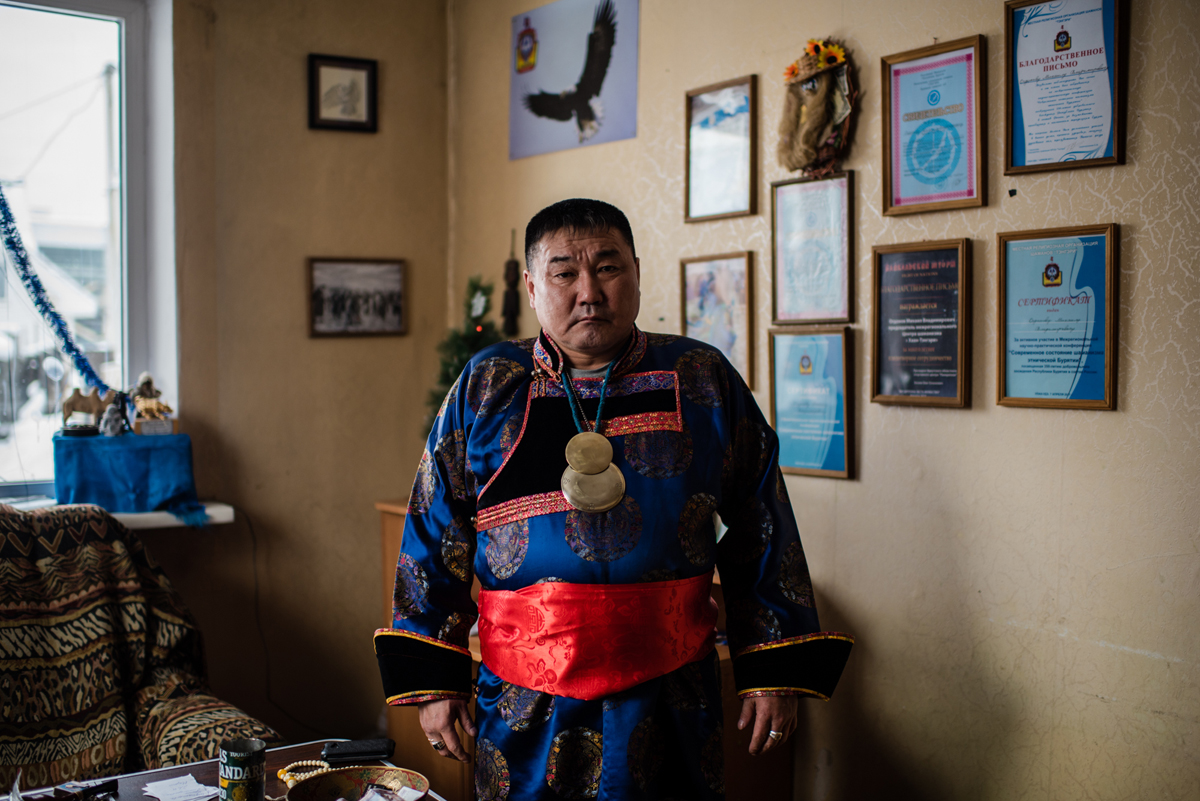
Mikhail Ogdonov, Irkutsk, at the office of the local shamanic religious organization “Baikal”
“You can’t just raise your hand and say, ‘I want to be a shaman!’ No. It comes from above. It is granted by your ancestors—the ongons. I have eight ongons, tracing back eleven generations. I used to work in the police force, but now I’m retired.
I was initiated into shamanism in absentia while still serving in the police. The ongons can choose anyone, but in large families, they usually pick either the eldest or youngest child. I am the youngest of ten siblings.
Shamans are selected for their physical resilience and wisdom. They are also tested in extreme ways. I was stabbed and shot at while on duty. I survived two major car accidents—one while my brother was driving, the other with my son-in-law at the wheel. These trials are so severe that a person either completely falls apart or endures. A shaman must be spiritually strong.”
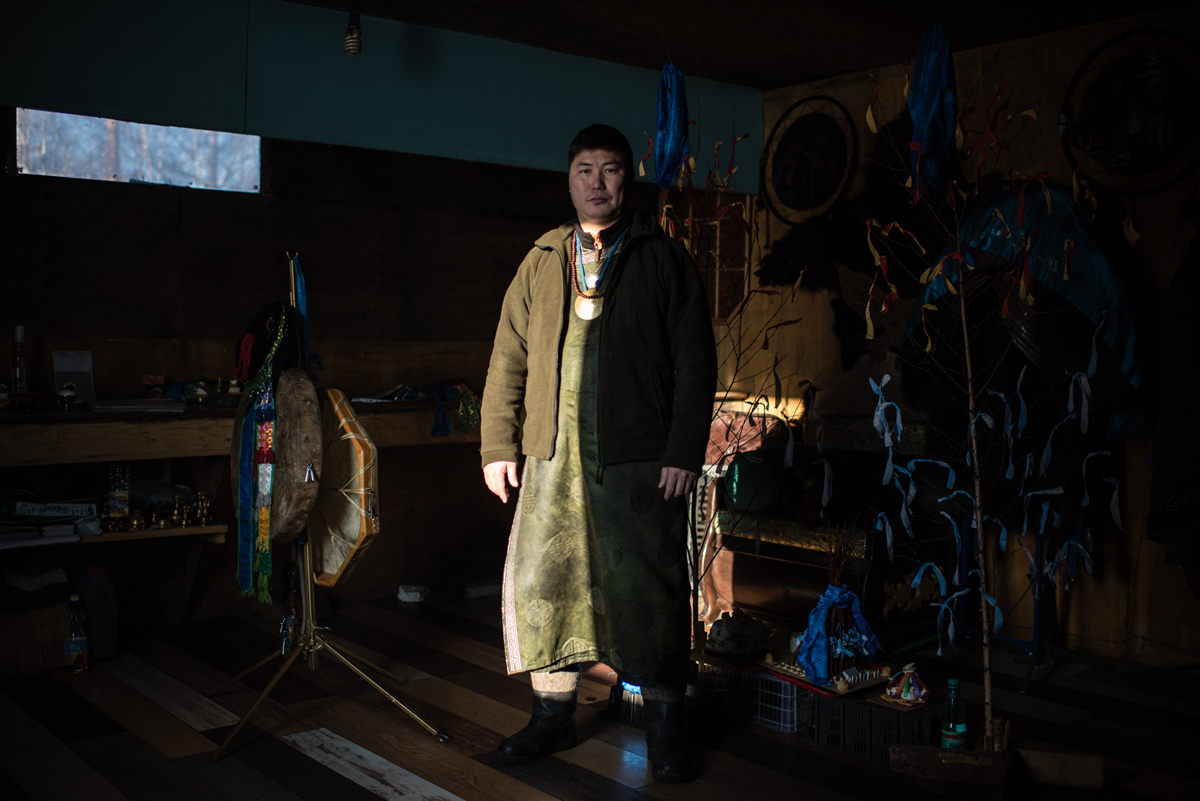
Arthur Tsybikov, Angarsk, interviewed in the working yurt of the local shamanic religious organization “Ever Blue Sky”
“I have been practicing since 2007. I am a hereditary shaman. My uncles, aunts, grandparents, and even my father were all shamans. It runs in the blood. I grew up witnessing rituals, and at 37, I formally embraced my calling.
Shaman sickness manifests differently in each person. It is not always linked to alcoholism. I have never smoked or drunk alcohol in my life. For me, the sickness revealed itself as relentless bad luck. No matter what I started, it failed. I studied in multiple universities, worked various jobs—janitor, security guard, nurse, even an assistant to the singer Iosif Kobzon. I served in the special forces. The 1990s were a turbulent time; many of my friends were killed. Life threw everything at me.
By the time I turned 37, I had accumulated experience and knowledge. When I was told I had to become a shaman, I accepted it. I realized this was my path all along. Since childhood, I had known I would either become a doctor or a shaman. I just didn’t know when.”
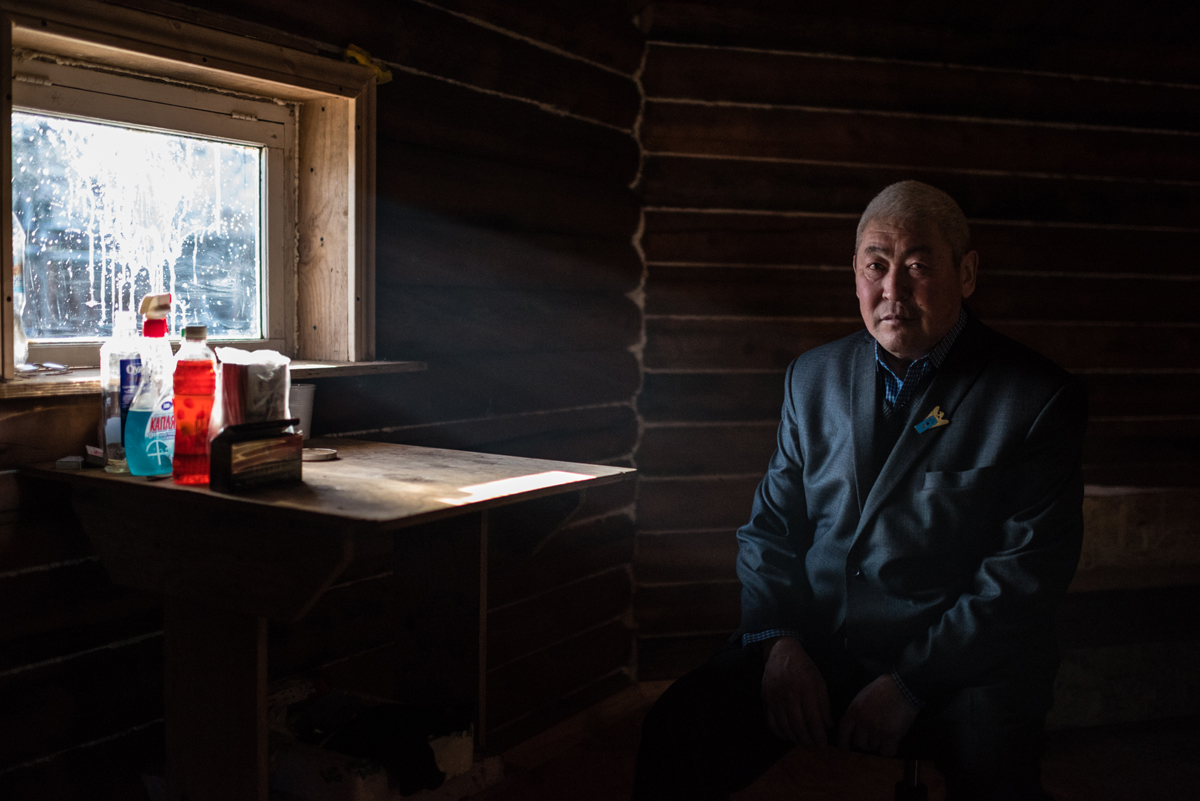
Yuri Bubayev, Ust-Ordynsky, interviewed in the yurt of the local shamanic religious organization “Heavenly Radiance”
“I was an accountant. I worked for the tax service and even led it at one point. Then, over three years, the shaman sickness took hold. By age 35, people began asking me to perform rituals, but I refused. I had a good salary in the tax service.
Doctors grew frustrated with me: two years of therapy, then surgery. But I wanted to live. I had to change my path, to serve the divine. At 37, I began practicing. I have been helping people for 15 years now, and I haven’t stepped inside a hospital since.”
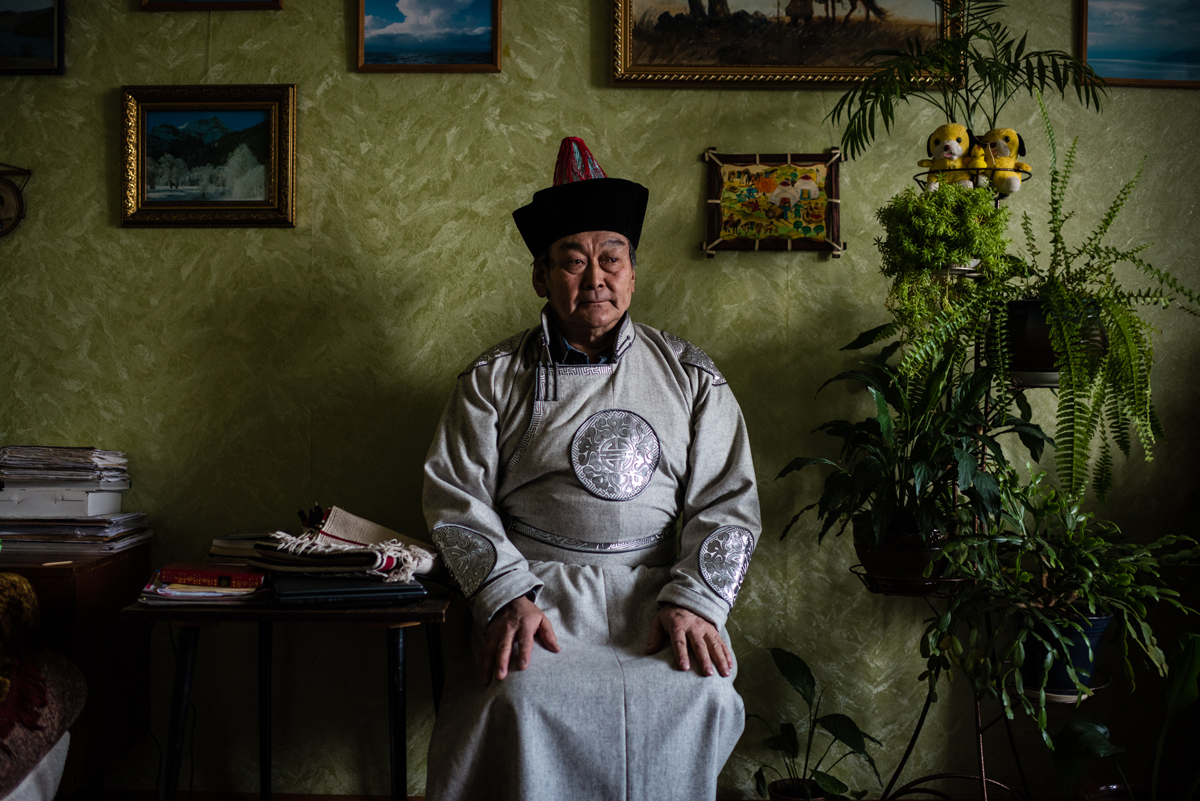
Victor Motoshkin, Irkutsk, at home
“I have a PhD. When I returned to my homeland, I knew nothing about shamanism because all the shamans in my native village had passed away. Then, one night, I had a dream: five people stood before me. Two were experienced shamans I recognized; the other three were shadowy figures. One of them said, ‘You must begin this work.’
When the spirits command you, you cannot disobey. The consequences are severe. I sought advice from a respected shaman in Ust-Ord and explained my dream. I told him, ‘I have no shamans among my close relatives. What does this mean?’
He performed a divination ritual and told me, ‘This is your destiny. There is no other path for you.’
It took two years to complete my initiation, spanning two summers. In the first year, we sacrificed seven sheep, and in the second year, two more. One elder shaman commented, ‘Few undergo such an extensive initiation. Usually, only two sheep are sacrificed. You did everything correctly.'”
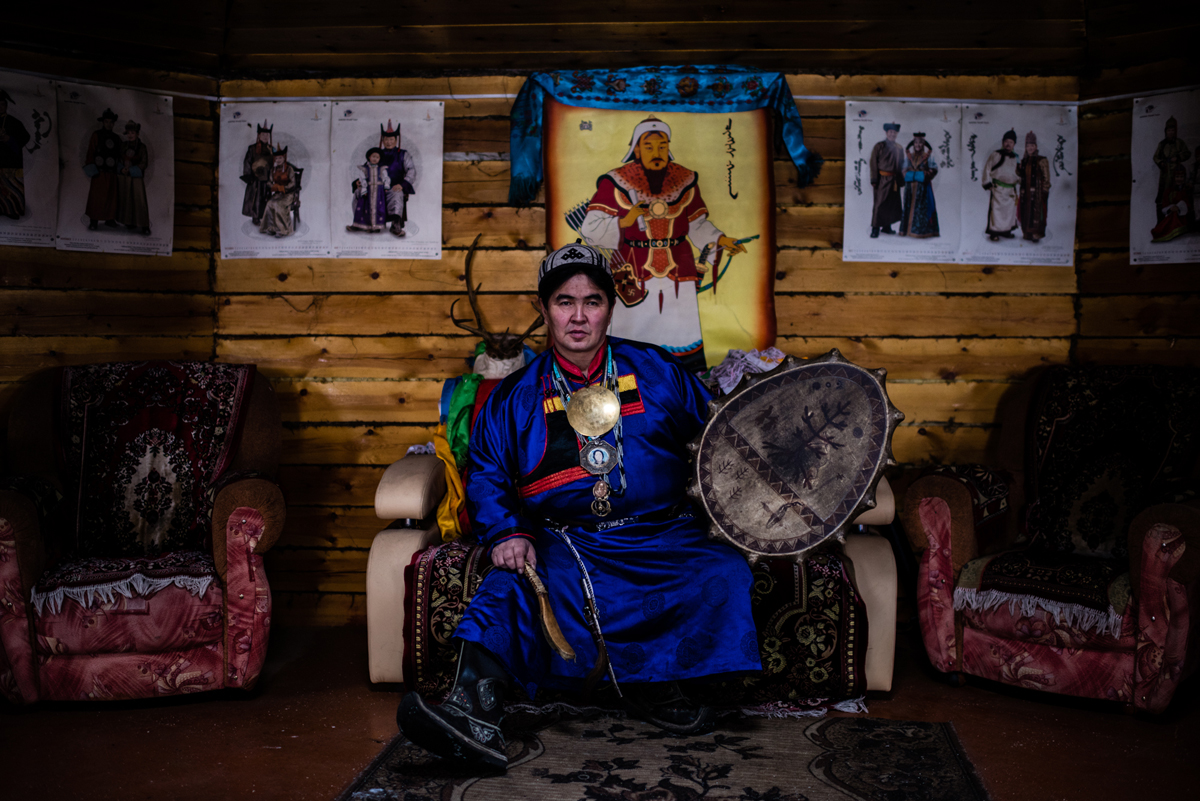
Valentin Hagdaev, Yelantsy – In the “Working” Yurt at Home
“I am a traditional shaman. I was born in a yurt. My grandfather was a shaman, and I was raised by my grandparents. I was born with a sign—a sixth finger. The Mongolian shaman Tseren-Zayrana once said: ‘Only once in a hundred years is a shaman born with an extra bone, proving that they are a true, genuine shaman.’
I am the only one in this region with six bones. It’s as if the heavens have given me a diploma. A church priest receives a piece of paper confirming his priesthood. But what if that priest fails? If he’s involved in financial fraud, if he steals from the church, he is stripped of his title—he can become a taxi driver or something else entirely.
But for me, I am a shaman for life. I may be a good shaman or a bad shaman, but I cannot lose my identity. Even if I were to engage in deception—though what kind of scheme could I even run? We have nothing public here. If people give money—good. If not—so be it. I treat everything and everyone equally.”e have nothing public here. If they give money — good. No — no. Equal attitude towards everything and everyone.”
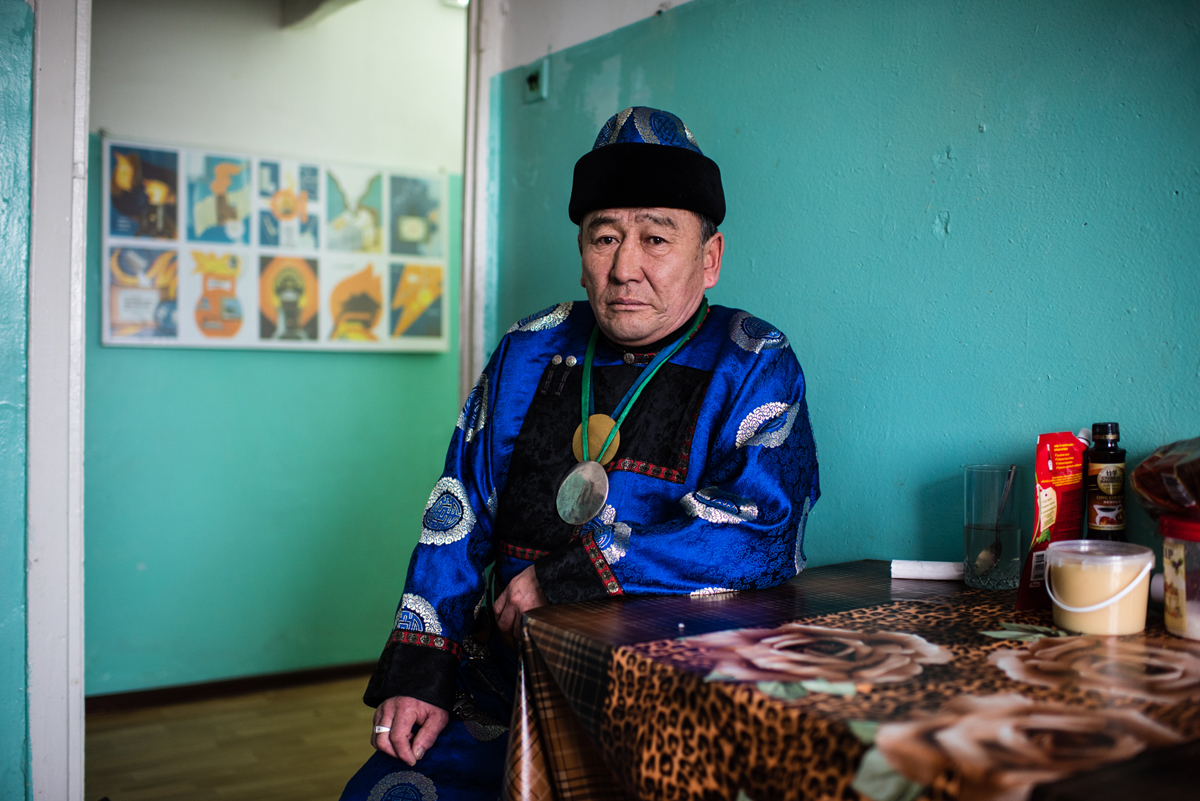
Gennady Tugulov, Irkutsk – At Home
“In my youth, I didn’t believe in shamanism at all, despite the fact that I had 12 ancestors who were shamans. They lived in the village of Kachug, beyond Lake Baikal.
Everything changed when I was called to Ulan-Ude. My nephew, who worked as a driver, ran into some trouble and asked me to accompany him to see a shaman. The shaman looked at me and said, ‘You must undergo the initiation of a shaman.’ And that is how I became one.
Shamans believe that the death of domestic animals precedes the emergence of a new shaman. He asked me, ‘Have any animals died recently?’ I replied, ‘Yes.’ He said, ‘That was a sign. You were meant to be a shaman.’
How does one become a shaman? You don’t simply choose it—you must be born into a lineage of shamans. Such a person experiences ‘shaman sickness.’ If you go to a doctor, they will give you a medical diagnosis. If you go to a shaman, they will tell you that it is the calling of the spirits. During this time, the person undergoes a transformation—they are reborn, and their life changes completely.
Being a shaman is incredibly difficult. It is hard work. A shaman cannot abandon their path—ancestral spirits will demand that they fulfill their role.
Nowadays, there are shamans as young as 30, and that is not good. At 30, you have no experience. You don’t even understand how you can help people. A shaman is needed to restore order, to help people live in purity. I believe that a good shaman can only truly help others after extensive life experience—after the age of 50.
There are different types of shamans—some heal, others foresee the future. There are nine levels of mastery. A shaman of the ninth level can ‘ascend’ and achieve great things.
On Olkhon Island, there are four shamans and two elders. Many people come to visit them. None of them advertise their work, and getting in touch with them is not easy—but that does not stop anyone.”
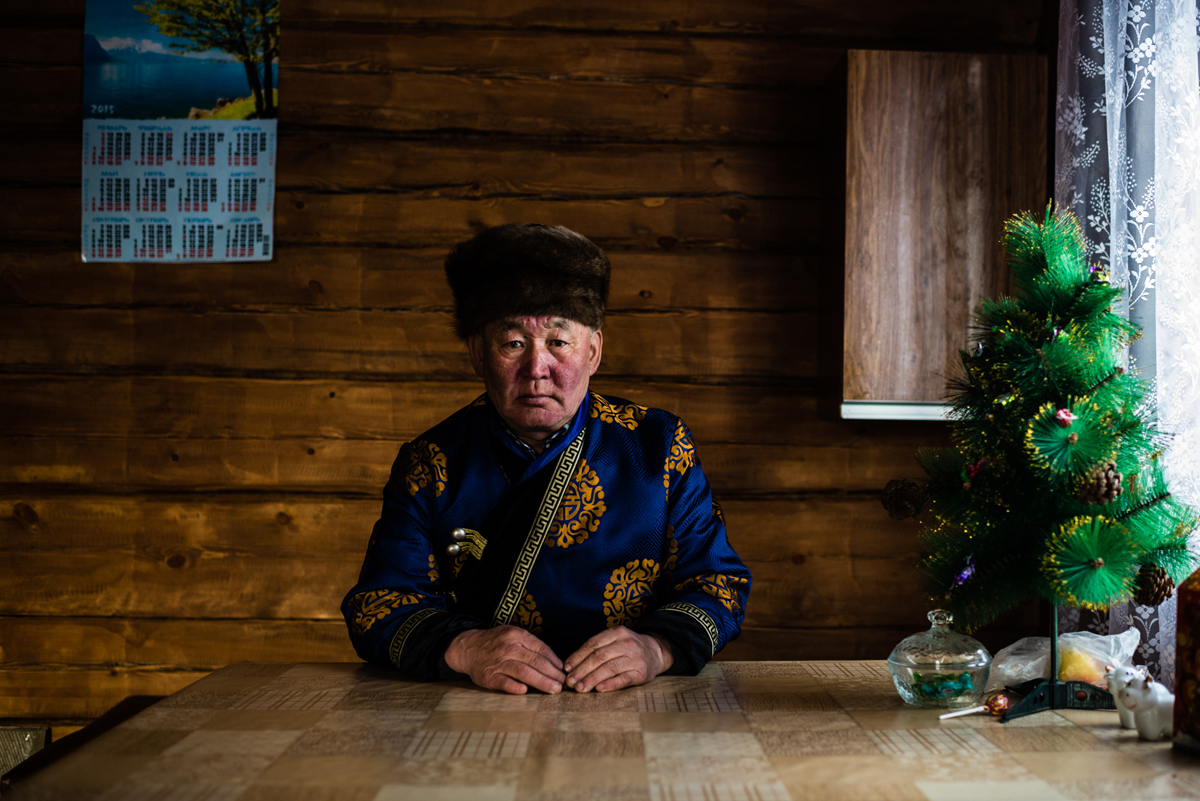
Boris Hungeev, Bayanday – At Home
“My ancestors were shamans on both my mother’s and father’s sides. That is why, when I reached a certain level of maturity, I began to practice a little. At 55, I fully embraced the rituals.
Not everyone can do this—far from it. One must have uddha—a pure bloodline—to perform such rituals.”
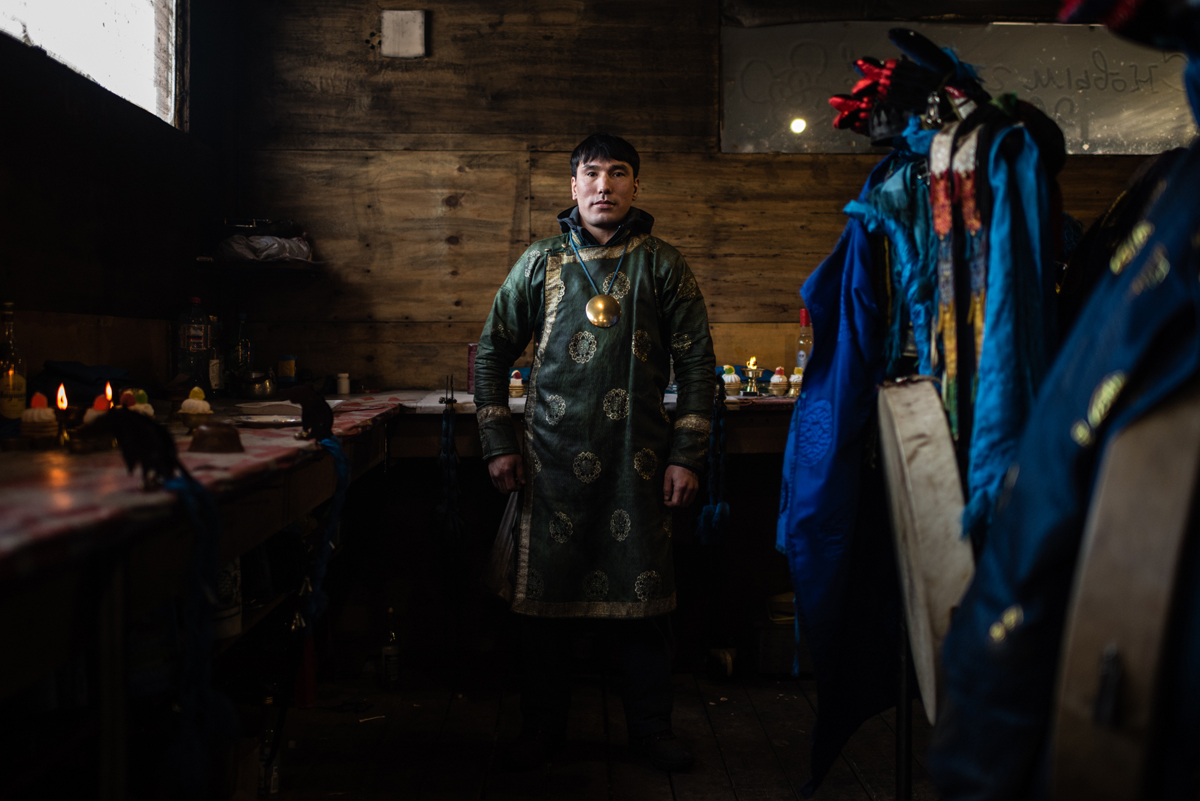
Matvey Bartsev, Angarsk – In the Working Yurt of the Local Religious Organization of Shamans, ‘Ever Blue Sky’
“The way people live today—their lifestyles, their values—has always been incomprehensible and uninteresting to me. Marriage, having children—why should I do any of it if I don’t even understand why I was born in the first place?
I used to love fighting, but then I delved into scripture and read extensively. It turns out that what I was experiencing was ‘shaman sickness.’ I could be irrational, I could fight, I could do things just to shock others.
When I fell ill, I began to lose my speech, fainting once a day. My friends brought me to Artur Vladimirovich, who later became my teacher. When I entered his home and saw all the tambourines and shamanic artifacts, I felt something deep inside me—I had found my place. I almost started dancing from sheer joy and relief.
Now, I understand why my son was born, why he will grow up, why his children will grow up. I know that the divinity of the universe must continue—that spirituality must be preserved on Earth. My lineage, my power, my purpose must endure.
And it is my duty to pass this understanding on to others, to awaken them—to help them see. That is our mission.”at my genetics, gender, power will remain. Respectively I should convey the same message to people so that they awaken, wake up. This is our task.”
Translated into English by ©Excellence Reporter
©Excellence Reporter 2018
Share this:

Categories: Shamanism





 Excellence Reporter